
Reviewed · WORKSHOPS
Hanoi Knife Making Traditional Workshop
Da Sy village gives this Hanoi outing real purpose: you are not simply watching a craft demonstration, you are working beside a family of blacksmiths and taking home a knife you helped make. I like the chance to choose your own knife design and the mix of hammering, handle work, sharpening, and local conversation.
I also like that hotel pickup, equipment, instruction, water, and the finished knife are included in the $50 price. Guides such as Tee, Nathan, Khoi, and Minh have helped visitors through the language gap with care. The main drawback is that this is a beginner class, so the master may handle the hottest or most dangerous stages. Experienced metalworkers may find the hands-on work limited.
Key points to know before booking
- Forge a practical souvenir: You take home the knife you help make, rather than a mass-produced trinket.
- Visit Da Sy village: The workshop sits in a Hanoi-area craft village known for generations of forging.
- Choose your design: You can select from sample knives or, in some sessions, show a photo or suggest your own shape.
- Expect active participation: You may sketch, hammer, shape, polish, sharpen, and work on the handle under supervision.
- English help is included: Your guide translates between you and the local knife-making family.
- Plan for heat and machinery: Wear comfortable shoes, follow instructions, and let the master handle the hydraulic cutter and other hazardous steps.
Why Da Sy village makes this more than a craft class
Da Sy, on the outskirts of Hanoi, has been tied to metal forging for several hundred years. Its work once included weapons during Vietnam’s wars. Today, the village is better known for agricultural tools and household knives, but the old forge-based trade still shapes daily work.
That background matters. You are not entering a staged workshop built only for visitors. You are meeting people whose family trade has continued through changing times. The class offers a small window into how useful tools are made in a Vietnamese craft village, where skill is passed through practice rather than a polished museum display.
The setting also gives you a reason to leave central Hanoi for a few hours. Hotel pickup is included, and a driver takes you to the village. The exact travel time is not provided, so allow room around the three-hour activity rather than booking a tight connection afterward.
More hands-on classes and workshops in Hanoi:
- Hanoi Cooking Class: Culture, Local Market & Meaning CSR Impact
★ 5.0 · 5,147 reviews - 5 Traditional Dishes Hanoi Cooking Class with Market Trip
★ 5.0 · 4,890 reviews - Hanoi Coffee Workshop: Taste Salt, Coconut and Egg Coffee
★ 5.0 · 1,286 reviews
Pickup, introductions, and the first design choice
Your English-speaking guide collects you from your hotel. You are asked to wait about five minutes in the lobby, which is a small but useful detail if you are staying in a large Hanoi hotel.
The guide is more than a driver or interpreter. Tee, Nathan, Khoi, and Minh are among the guides who have led sessions, and the strongest part of their role is explaining what the local craftspeople are doing. The artisans may not speak English, so the guide carries questions, instructions, and small bits of conversation between both sides.
Some guides also add informal local touches. Nathan has introduced visitors to Vietnamese fruit, tea, and candy during the visit. One guide even helped a hungry participant find a favorite food stop. Those extras are not guaranteed, but they show how the guide can shape the day beyond simple translation.
Before the metal gets hot, you choose what you want to make. You can select from several knife styles, and some sessions allow you to bring a photo or combine features from different designs. One participant created a hybrid inspired by a local style and a Japanese kiritsuke knife.
This choice gives the class a personal edge. You are not just copying an object that has already been prepared. You are deciding what kind of tool you want to carry home. Ask questions at this stage, especially about blade shape, handle size, and how much of the work you want to do yourself.
Sketching the blade and preparing the steel
The process begins with a simple drawing. You sketch the blade shape onto a sheet of metal selected for durability. This is the point where the finished knife starts to become your own project.
The blade and tang are then cut from the metal. The tang is the section that extends into the handle, so it is an important part of how the knife comes together. You may help with this stage, but the workshop uses cutting equipment, and the master will decide which parts are safe for you to handle.
The guides and artisans explain each step before asking you to try it. That makes the class suitable for someone with no blacksmithing background. You do not need prior craft skills, but you do need to pay attention and accept that some jobs belong in experienced hands.
At the forge: hammer, anvil, and teamwork
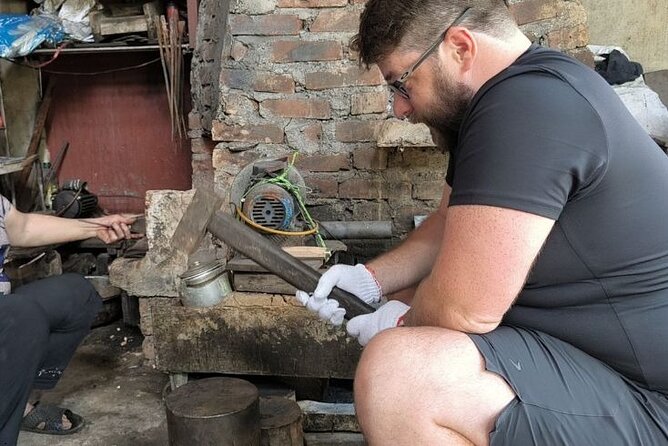
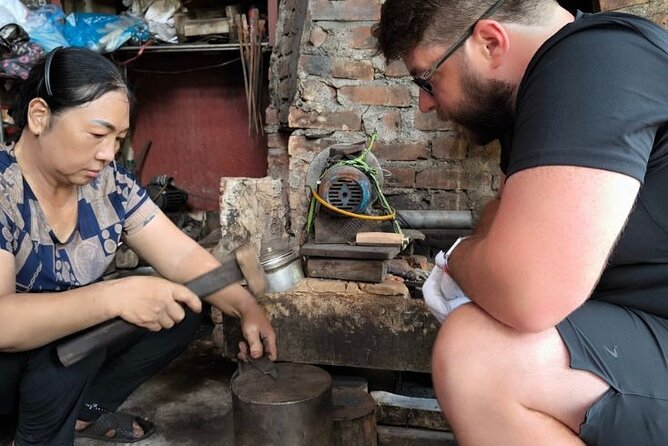
The most memorable part is the forge. The cut metal goes into crackling embers, then you and the maker shape it with hammer and anvil. You alternate blows, following the craftsperson’s rhythm and direction.
This is hands-on, but it is not an unsupervised blacksmith lesson. The maker may guide your grip, correct your stance, or take over when the metal, tool, or temperature becomes unsafe. That balance is sensible. You get a feel for the force and timing involved without being left alone beside hot metal.
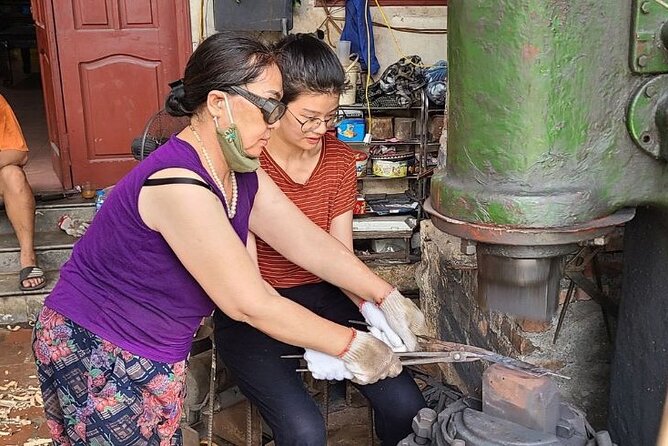
One practical point is worth stressing: the work can be physically demanding and hot. Comfortable shoes are specifically recommended. Gloves are also a wise choice when offered, and one participant gave the plain advice to use them and keep your fingers safe.
After the hammering, imperfections are trimmed with a hydraulic cutting machine. This is one of the stages you should expect the master to control. It is fascinating to watch, but it is not a place for casual experimentation.
Something completely different for the rest of your time in Hanoi:
- Hanoi Jeep Tour: Food, Culture and Fun by Vietnam Army Jeep
★ 5.0 · 15,222 reviews - Full-Day Ninh Binh Highlights Tour from Hanoi
★ 5.0 · 7,761 reviews - Hanoi: Ha Long Bay Day Cruise – Swimming, Meal, Kayaking
★ 4.7 · 7,415 reviews - Hanoi: Water Puppet Show Tickets
★ 4.6 · 7,029 reviews
Shaping, sharpening, and the secret family wash
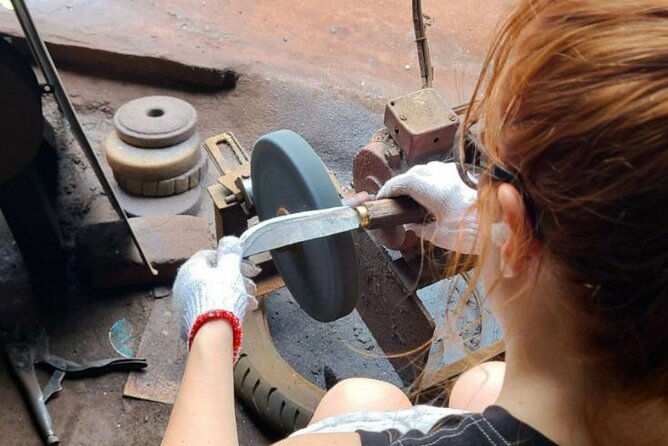
Once the rough blade is formed, it is refined and sharpened on a grindstone. The sharpening process has several phases, and the artisan works toward a blade that is not just attractive but genuinely useful.
One stage includes soaking the blade in a tar-based chemical wash made from a family recipe. You will not learn the formula, but you can see that the finish is not simply a matter of grinding steel until it looks bright. Heat, treatment, shaping, and sharpening all affect the final result.
The final blade can be remarkably sharp. Take care when it is handed to you, and do not treat the finished knife like a harmless souvenir. It is a working tool, not just a display piece.
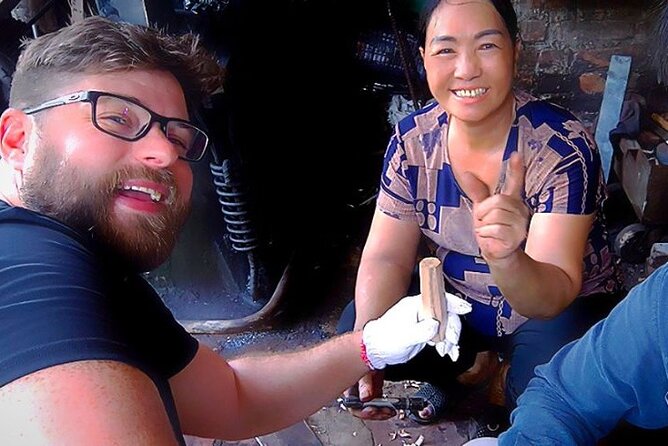
The handle may also be part of your work. Several sessions included carving or fitting the wooden handle, and some participants appreciated being able to shape it to fit their hands. This is a valuable part of the class because it shows that a knife is more than a blade. Balance, grip, and comfort matter just as much.
How much of the knife will you really make?
This is the key expectation to set before booking. The experience is designed for true beginners. You can take part in many steps, but the master will complete or control the most dangerous work and may correct portions that affect the knife’s safety or quality.
For some people, that is exactly right. You get a safe introduction, clear demonstrations, plenty of help, and a finished knife that works. The class does not require you to arrive with metalworking experience or confidence around a forge.
If you already make knives or work with metal, you may want more independence. Some participants felt that a few hammer blows and short tasks did not amount to a full technical lesson. Ask your guide at the beginning how much you may do, since the level of participation can vary with your confidence and the group.
The best approach is to treat this as a supervised craft experience, not professional training. You will gain a better sense of the work and contribute to your knife, but you will not leave ready to run a forge alone.
A family workshop and a useful souvenir
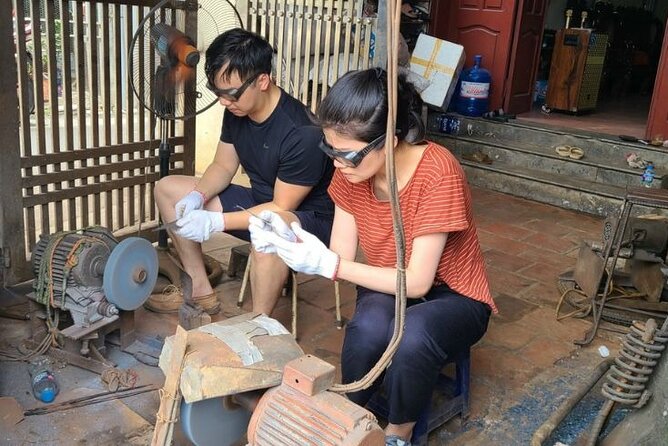
The family-run setting is one of the strongest parts of the day. The local makers demonstrate with patience, adjust your technique, and help make sure the result is sound. One craftswoman, Do Thi Tuyen, has been described as having decades of experience, and visitors have worked with her while the guide translated.
That direct contact gives the class warmth. You are not only pressing a button or observing behind glass. You are standing beside the people who know the trade, asking questions through the guide, and sharing the small laughs that come with learning a new physical skill.
The finished knife is the reward. It is a practical reminder of Hanoi, and several designs can look surprisingly polished once the artisans finish the blade. You may also have a chance to purchase additional knives from the workshop at a reasonable price, although extra purchases are not part of the stated package.
Check your airline and destination rules before packing the knife for your journey home. The activity information does not specify shipping or transport rules, so you should handle that question directly with the provider before departure.
Group size, guide quality, and the feel of the morning
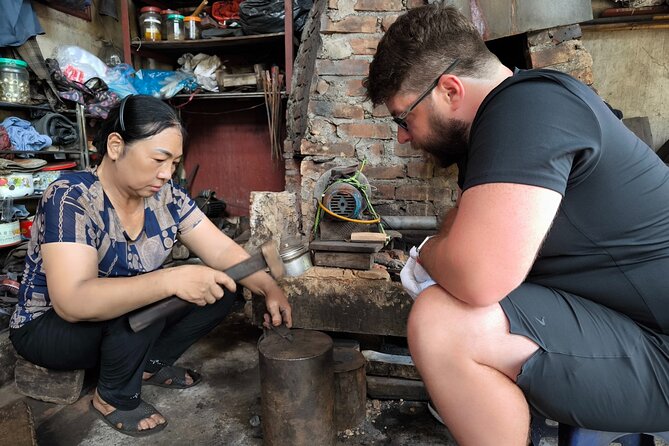
Small groups are available, and some sessions have been private or shared by only two people. That matters here. A forge class works better when the guide has time to translate and the master can watch each person’s hands.
Larger groups can still work, as shown by a session for six people in which everyone selected and made a knife. Still, if personal instruction is important to you, request a small or private group when booking. It may give you more time at the anvil and more opportunity to ask about the craft.
The guide is central to the experience. Tee has been praised for explaining the process and translating throughout. Nathan has helped with detailed demonstrations and conversation. Khoi has accompanied visitors from hotel pickup through the return journey, and Minh has guided groups with clear English instructions. Names and assignments can change, but the activity includes live English guidance.
Is $50 a fair price?
At $50 per person, the value is strong if you want an active outing and a one-of-a-kind souvenir. The price includes hotel pickup, transport to the village, an English-speaking guide, the local master, equipment, water, and the knife you make.
You are also paying for time with a skilled craft family, not only for raw materials. A simple knife purchased in Hanoi would cost less, but it would not carry your work at the forge or the memory of shaping the handle and blade.
The value is weaker if you only want technical instruction. Since the master handles some stages, a serious knife enthusiast may prefer a longer workshop with more control over heat treatment, grinding, and finishing. For a first taste of blacksmithing, though, the combination of access, guidance, transport, and a usable product makes the fee reasonable.
The advertised duration is three hours. Some individual accounts describe a session closer to two hours, so allow flexibility and confirm the starting time when you check availability.
What to bring and who should skip it
Wear comfortable, closed shoes suited to standing and moving around a working forge. Follow all safety directions, especially around the fire, grindstone, chemical wash, and hydraulic cutter.
Alcohol and drugs are not allowed. The experience is not suitable for people over 95, according to the activity information. The class also requires enough mobility and attention to participate safely, though no previous knife-making skill is needed.
I would recommend it to couples, families with older children or teens, solo visitors who enjoy making things, and anyone tired of collecting ordinary souvenirs. It also suits people who want a short rural break from Hanoi without giving up a clear activity.
I would think twice if you dislike heat, noise, workshop mess, or close supervision. It may also disappoint you if you expect to carry out every stage alone.
Should you book the Da Sy knife-making class?
Book it if you want a personal souvenir, a look at a working Vietnamese craft village, and a guided chance to handle the basic tools of a forge. The best reason to go is not that you will become a blacksmith in three hours. It is that you will understand, through your own hands, how much skill goes into an everyday knife.
Before paying, confirm the pickup area, starting time, group size, and how much of the process you can perform yourself. If those details suit you, $50 buys a thoughtful half-day experience with transport and a finished knife to remember Hanoi by. Free cancellation is available up to 24 hours before the activity, and you can reserve now and pay later, which helps if your Hanoi schedule is still shifting.
FAQ
Where does the knife-making class take place?
The class takes place in Da Sy village, a traditional forging village on the outskirts of Hanoi. The activity information lists the location as Dong Bac, Vietnam.
How long does the activity last?
The listed duration is three hours. Check availability for the available starting times.
What is included in the $50 price?
The price includes English-speaking instruction, one 500-milliliter bottle of water, the local master, equipment, and the knife or other product you make. Hotel pickup is also included.
Is hotel pickup available?
Yes. The provider picks you up at your hotel. You should wait about five minutes in the hotel lobby.
Is the class offered in English?
Yes. The activity includes a live English-speaking guide. The guide helps translate between you and the local knife-making family.
Can I choose the knife design?
Yes. You can choose from available knife designs, and some sessions allow you to use a photo or create a variation of your own.
Do I make every part of the knife myself?
You take part in the main stages, including design, forging, shaping, sharpening, and handle work when available. The master may control dangerous steps, including work with the hydraulic cutting machine.
What should I bring?
Bring comfortable shoes. Gloves and careful attention are also sensible around the hot metal and machinery.
Can I cancel or pay later?
You can cancel up to 24 hours in advance for a full refund. Reserve now and pay later is available. A $10 surcharge applies during New Year, Tet, Liberation Day or Reunification Day on April 30, International Workers’ Day on May 1, and National Day on September 2.
Just added to the Hanoi list
- (TOP) Private car: Hanoi/Noi Bai Airport (HAN) from/to Ninh Binh★ 3.5 · 16 reviews
- Thang Long Water Puppet Theater★ 4.5 · 45 reviews
- Private car transfer from Hanoi Airport to Hotels★ 4.5 · 5 reviews
- Private Hanoi Old Quarter Food Tour with 8+ Authentic Tastings★ 5.0 · 11 reviews
- Private Tour Ninh Binh 1 Day★ 5.0 · 5 reviews
- Private Transfer Service from Hanoi to Ha Long Bay★ 5.0 · 3 reviews
- Private Transfer Between Hanoi City and Noi Bai Airport (HAN)★ 5.0 · 3 reviews
- Ba Be National Park With Boat Trip, Kayaking, Swimming, Trekking And Cycling★ 5.0 · 10 reviews
Workshops, compared.

Hanoi Cooking Class: Culture, Local Market & Meaning CSR Impact
Read our review →
5 Traditional Dishes Hanoi Cooking Class with Market Trip
Read our review →
Hanoi Coffee Workshop: Taste Salt, Coconut and Egg Coffee
Read our review →
Salt Coffee Workshop Awake Your Senses With 6 Brews
Read our review →
Vietnamese Food Cooking Class in Hanoi with Market Experience
Read our review →
Handcrafted Wood Carving Workshop with Local Artisan
Read our review →
5 Local Dishes Cooking Class with Meal & Market Visit
Read our review →
Hanoi Cooking Class and Market Tour in Ancient House
Read our review →Browse the lists this tour appears in