
Reviewed · WORKSHOPS
Hanoi Knife Making Traditional Workshop
A glowing blade, a heavy hammer, and an old village forging tradition make this one of Hanoi’s more unusual half-day outings. You sketch a blade, cut the metal, work it over hot coals, and sharpen it on a grindstone. This is not a polished craft demonstration. You take part.
I like the hands-on work and the chance to meet the family that has forged tools for generations. I also like the small group limit of 10, which gives you a better chance to get patient help at the anvil. If Nathan is your guide, expect an engaging companion who helps keep the trip moving.
The main consideration is comfort. This is a working forge, not a cool museum, and the activity calls for moderate physical fitness. The class also lasts about three and a half hours, so it may feel demanding if you dislike heat, repetitive hammering, or practical workshop conditions.
Key points to know before you book
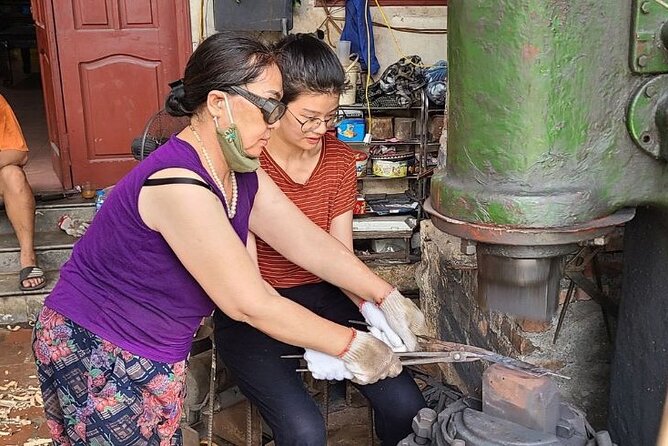
- You make a real knife: Sketch the blade, cut the metal, forge it, shape it, and sharpen it.
- The workshop carries a family tradition: The craft has been passed down for generations, with some family members beginning around age 12.
- This is a village visit outside Hanoi: You leave the city for a craft community known for forging agricultural tools.
- The guide matters: An English-speaking guide is included, and Nathan has been praised for being patient and entertaining.
- The group stays small: The maximum is 10 people, useful when several visitors need time at the anvil.
- The $50 price includes transport and materials: Lunch and tips cost extra, but the essential workshop supplies are covered.
Leaving Hanoi for a centuries-old forging village
The experience begins in Hanoi, with pickup offered in an air-conditioned vehicle. The exact pickup timing is not provided, so you should confirm the details when booking. The workshop is on the outskirts of the city, in a village known for its forging profession.
That setting matters. You are not simply watching a staged craft display in a city shop. The village has long produced forged goods, first including weapons during the Vietnam wars and now more commonly agricultural implements. The work remains tied to daily life rather than being presented only as a souvenir tradition.
You will meet local family members and see the place where the craft is practiced. The family has worked in the field for generations, and one account notes that people in the trade may begin learning as young as 12. That detail helps explain the speed and control of the makers. They have spent years learning how metal reacts to heat, force, and cooling.
The vehicle is air-conditioned, a useful inclusion in Hanoi’s warm climate. Pickup also removes some of the fuss of getting to an unfamiliar village on the city’s edge. Still, this is a practical outing rather than a luxury day tour. Lunch is not included, and the total experience is only about three and a half hours.
More hands-on classes and workshops in Hanoi:
- Hanoi Cooking Class: Culture, Local Market & Meaning CSR Impact
★ 5.0 · 5,147 reviews - 5 Traditional Dishes Hanoi Cooking Class with Market Trip
★ 5.0 · 4,890 reviews - Hanoi Coffee Workshop: Taste Salt, Coconut and Egg Coffee
★ 5.0 · 1,286 reviews
Drawing a blade you can actually use
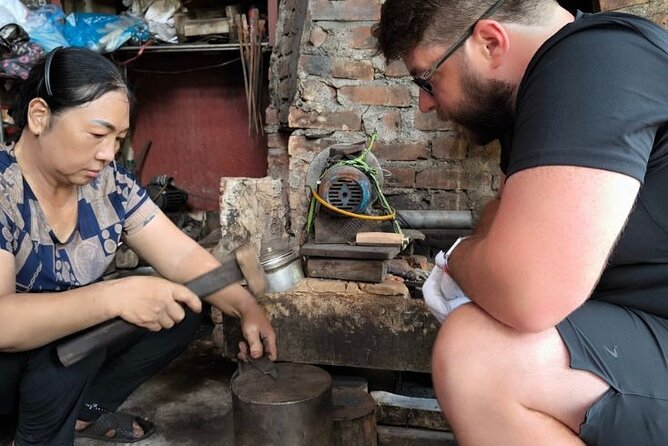
Your first job is to sketch the shape of the knife on a sheet of metal. The material is selected for durability, so you are beginning with a functional object rather than a decorative trinket.
This design step sounds simple, but it is where you make an important choice. The size and shape affect how the finished knife feels and what it can do. One account notes that participants are allowed to choose the size of the knife, though the full details of the available options are not specified.
Do not expect to produce a finely detailed custom blade in the manner of a professional bladesmith. You are making a simple knife during a short workshop, with experienced makers handling parts of the process and correcting rough edges. That is the right balance for a beginner. You get a real role without being left alone with a dangerous piece of equipment.
The family members are described as patient and helpful, which matters here. Metalwork is not intuitive on the first attempt. Clear guidance at this stage gives you a better chance of ending with a blade that is both recognizable and usable.
The anvil, hammer, and heat of the forge
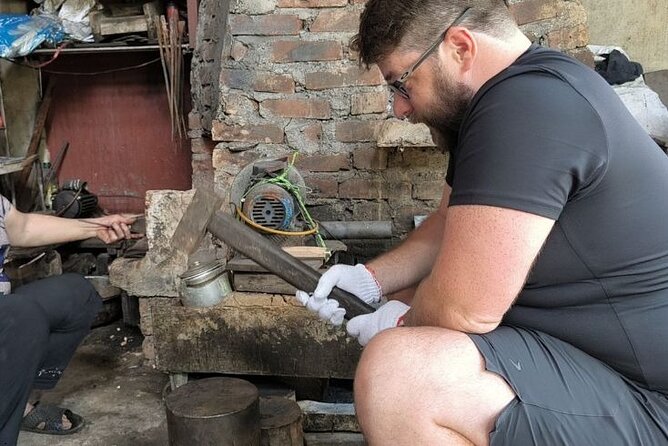
Next comes the part most people picture when they hear knife making: cutting and forging the metal. Using a hammer, cutter, and anvil, you shape the blade and tang. The tang is the narrow section that extends into the handle.
The metal is placed into crackling embers before you work it. You then alternate blows with the maker, striking the heated metal to bring it toward the planned form. This is where the class becomes physical. You need enough strength and coordination to handle the tools, but the experienced maker remains close to guide the work.
You will not be expected to copy a family blacksmith’s years of practice in a single session. Your role is to learn the feel of the process and contribute to the shaping. The rhythm of hammering, reheating, and adjusting shows why forged tools take skill. A blow that is too light may do little. A blow in the wrong place can distort the form.
A hydraulic cutting machine trims imperfections after the main shaping. This is an important practical detail. The workshop is not pretending that every beginner’s strike will be perfect. The machine helps bring the blade back toward a clean shape, while you still take part in the more traditional work.
The noise, heat, and repetitive movement are part of the experience. If you have a bad back, limited strength, or a strong dislike of hot workshops, think carefully before booking. The moderate fitness requirement is worth taking seriously.
Sharpening the blade on a family grindstone
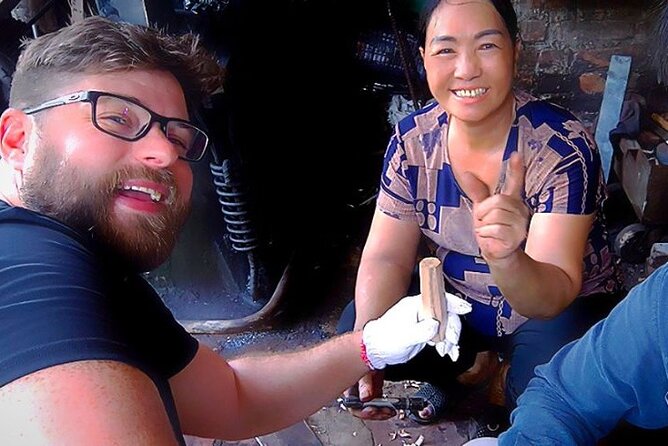
After forging and shaping, the knife is sharpened on a grindstone. This phase turns a rough metal form into something closer to a working blade.
Sharpening is not one quick pass. The process includes several stages, including a soak in a special tar-based chemical wash made from a family recipe. The recipe is described as a secret, so you should not expect a technical explanation of its ingredients.
That small detail gives the class a sense of place. You are not only using generic equipment in a standard craft lesson. You are seeing a method kept within the family, alongside modern help such as the hydraulic cutter. The workshop combines old handwork with practical machinery where it makes sense.
You should also keep your expectations measured. The experience promises a simple knife, not a museum-quality blade or a full professional apprenticeship. The value is in taking part in every main stage, from a blank sheet of metal to a sharpened object you can carry home.
The finished knife is a more unusual souvenir than the usual Hanoi purchase. It also has a clear story attached to it: you designed the basic form, worked the metal, and watched local makers finish the difficult parts.
Something completely different for the rest of your time in Hanoi:
- Hanoi Jeep Tour: Food, Culture and Fun by Vietnam Army Jeep
★ 5.0 · 15,222 reviews - Full-Day Ninh Binh Highlights Tour from Hanoi
★ 5.0 · 7,761 reviews - Hanoi: Ha Long Bay Day Cruise – Swimming, Meal, Kayaking
★ 4.7 · 7,415 reviews - Hanoi: Water Puppet Show Tickets
★ 4.6 · 7,029 reviews
What the family workshop adds
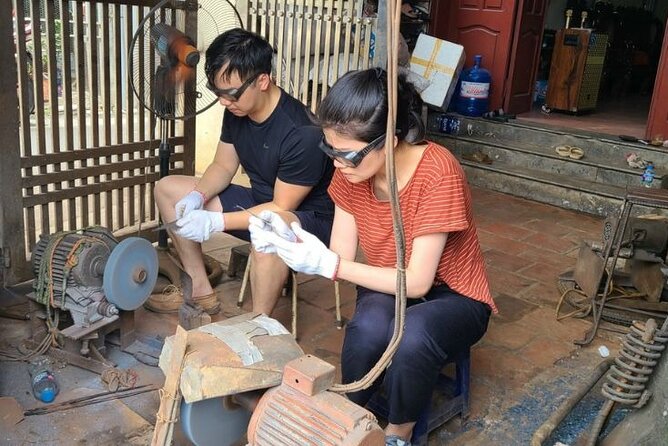
The local family is central to the appeal. You are not only paying for materials and transportation. You are spending time with people whose work has been handed down across generations.
That contact can be more meaningful than a short demonstration because you have something practical to discuss while working. The process creates natural conversation. You can ask about the tools, the village trade, and the way the craft is learned.
The small group limit helps. With no more than 10 people, the maker can give attention to several participants without turning the class into a crowd around one anvil. It does not guarantee private instruction, but it is a reasonable size for a hands-on workshop.
The English-speaking guide also provides useful support. Nathan is specifically praised for being patient, engaging, and entertaining during the journey. Guides can vary by departure, so treat Nathan as a possibility rather than a guarantee. Whoever leads your visit, the guide is included and can help bridge the gap between the family workshop and English-speaking visitors.
Is $50 a fair price?
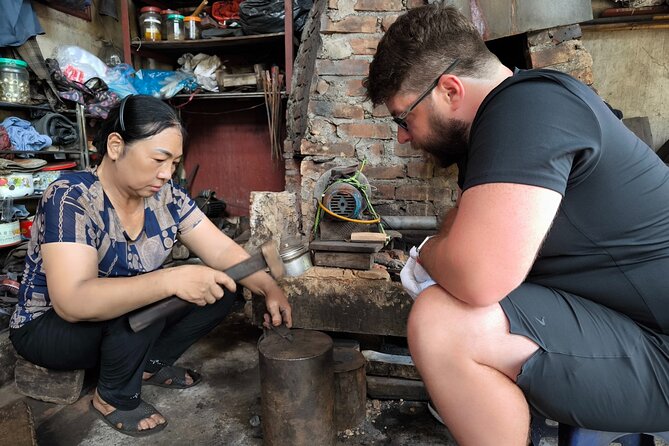
At $50 per person, this is not the cheapest half-day activity in Hanoi. It is also not simply a transfer to a village. The price includes an air-conditioned vehicle, iron material, and an English-speaking guide, along with access to a hands-on craft class.
I see the value in the combination. You get transport beyond central Hanoi, instruction, materials, local contact, and a finished object. If you bought a similar knife in a market, it would cost less, but it would not include the making process or the time with the family.
The class is a better buy for someone who values an activity over sightseeing. You are paying for participation, not a long list of city landmarks. If your main goal is to see Hanoi’s temples and old streets, this outing takes time away from them. If you want a practical encounter with a local trade, the price is easier to justify.
Lunch is not included, so plan around that. Tips are also not included. The available information does not specify the pickup area, the exact village name, or the meal arrangements, so ask for those details before you finalize your plans.
Who will enjoy this most?
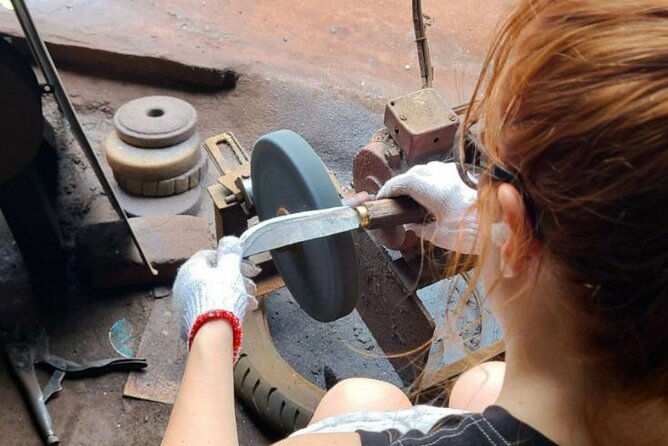
This class fits curious adults, older children who can follow safety instructions, couples looking for a shared project, and solo visitors who enjoy meeting local makers. It also suits people who already have an interest in tools, cooking, metalwork, or unusual souvenirs.
You do not need blacksmithing experience. The whole point is to learn the basic process under supervision. Patience matters more than technical skill.
I would be cautious about booking if you want a relaxed, cool, seated excursion. The forge involves heat, hammering, cutting, and grinding. The experience requires moderate physical fitness, and the total time is long enough for the physical work to feel real.
The knife itself may also raise practical questions for your return journey. The information provided does not explain packing or airline rules, so check your carrier’s policy before you book if you are flying with hand luggage.
How the timing and group size shape the day
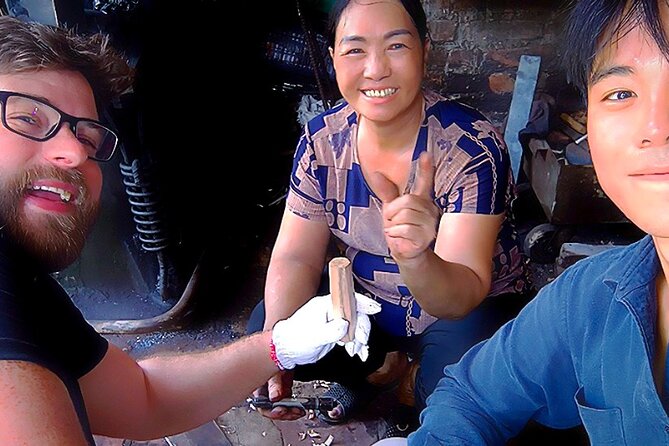
Three and a half hours is enough time to cover the main steps without turning the class into a full-day commitment. You can leave Hanoi, meet the makers, work through the knife-making stages, and return without giving up an entire day of sightseeing.
The compact schedule also means the lesson must stay focused. You will not have unlimited time to experiment with shapes or repeat every stage. The makers will need to step in, trim imperfections, and move the blade forward.
A group of up to 10 is a sensible limit for this kind of work. A larger group could leave you waiting for tools or standing behind other people. Here, you should have a more direct role, though the exact amount of hammering time can depend on the group and the maker’s approach.
The mobile ticket is convenient, and confirmation is sent at booking. Free cancellation is available if you cancel at least 24 hours before the start time. Inside that window, no refund is provided. Poor weather or failure to reach the minimum number can lead to a new date, another experience, or a full refund.
Should you book the Hanoi knife-making workshop?
Book this if you want an unusual Hanoi experience with a real task at its center. The family workshop, the forged agricultural tradition, the chance to work at an anvil, and the finished knife give the outing more substance than a quick photo stop.
I especially like it for repeat visitors and anyone who has already seen Hanoi’s main sights. It also makes sense for a first-time visitor who wants one half-day outside the city and prefers meeting local makers to sitting on a sightseeing bus.
Skip it if you want a gentle tour, if heat and hammering sound unpleasant, or if your schedule is too tight for a three-and-a-half-hour activity. At $50, the class earns its price through the instruction, transport, materials, and personal result. You are not just buying a souvenir. You are paying to help make one.
FAQ
Where does the knife-making workshop take place?
The activity begins in Hanoi and visits a traditional craft village on the outskirts of the city. The village is known for its forging profession.
How long does the experience last?
The workshop lasts approximately 3 hours and 30 minutes.
What will I make during the class?
You will make a simple knife. The process includes designing the blade, cutting the metal, forging it, shaping it, and sharpening it.
Is transportation included?
Yes. An air-conditioned vehicle is included, and pickup is offered.
Is an English-speaking guide included?
Yes. An English tour guide is included. Nathan is one guide associated with the experience, though guide assignment can vary.
How many people can join the activity?
The maximum group size is 10 travelers.
Do I need previous knife-making experience?
Previous experience is not listed as a requirement. You will be guided through the knife-making process by the local makers and the English-speaking guide.
Do I need a certain fitness level?
A moderate physical fitness level is recommended. The activity includes hammering, cutting, forging, and sharpening.
Is lunch included?
No. Lunch is not included in the price.
Can I cancel for a full refund?
Yes, if you cancel at least 24 hours before the experience start time. Cancellations made less than 24 hours in advance are not refunded. Changes inside that 24-hour period are also not accepted.
Just added to the Hanoi list
- (TOP) Private car: Hanoi/Noi Bai Airport (HAN) from/to Ninh Binh★ 3.5 · 16 reviews
- Thang Long Water Puppet Theater★ 4.5 · 45 reviews
- Private car transfer from Hanoi Airport to Hotels★ 4.5 · 5 reviews
- Private Tour Ninh Binh 1 Day★ 5.0 · 5 reviews
- Private Hanoi Old Quarter Food Tour with 8+ Authentic Tastings★ 5.0 · 11 reviews
- Private Transfer Service from Hanoi to Ha Long Bay★ 5.0 · 3 reviews
- Private Transfer Between Hanoi City and Noi Bai Airport (HAN)★ 5.0 · 3 reviews
- Ba Be National Park With Boat Trip, Kayaking, Swimming, Trekking And Cycling★ 5.0 · 10 reviews
Workshops, compared.

Hanoi Cooking Class: Culture, Local Market & Meaning CSR Impact
Read our review →
5 Traditional Dishes Hanoi Cooking Class with Market Trip
Read our review →
Hanoi Coffee Workshop: Taste Salt, Coconut and Egg Coffee
Read our review →
Salt Coffee Workshop Awake Your Senses With 6 Brews
Read our review →
Vietnamese Food Cooking Class in Hanoi with Market Experience
Read our review →
Handcrafted Wood Carving Workshop with Local Artisan
Read our review →
5 Local Dishes Cooking Class with Meal & Market Visit
Read our review →
Hanoi Cooking Class and Market Tour in Ancient House
Read our review →Browse the lists this tour appears in