
Reviewed · WORKSHOPS
Hanoi Knife-Making Class:Join the Legacy in Blacksmith’s Workshop
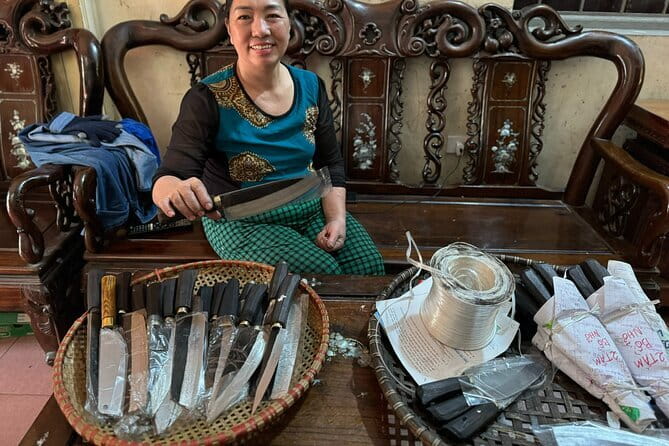
Da Sy’s knife makers have forged tools and weapons for centuries, and this class puts you at the anvil rather than behind a glass case. You design a blade, heat the metal, hammer it into shape, and finish it with a grindstone. Artisan Tuyen, the only officially recognized woman in this trade, brings 44 years of experience to the workshop.
I like two things right away: you make a real, usable knife, not a token souvenir, and the work takes place in the artisan’s home workshop. Guides such as Mint, Nick, and Tulip help explain the process and keep beginners on track. The main consideration is that this is hands-on forge work, not a quiet craft lesson. Expect heat, hammering, grinding, and some effort.
Key points at a glance
- Da Sy village setting: Work in a long-established blacksmith community outside central Hanoi.
- A rare female artisan: Tuyen has spent 44 years preserving the knife-making craft.
- A full knife from start to finish: Design the blade, forge the metal, shape the edge, carve the handle, and sharpen it.
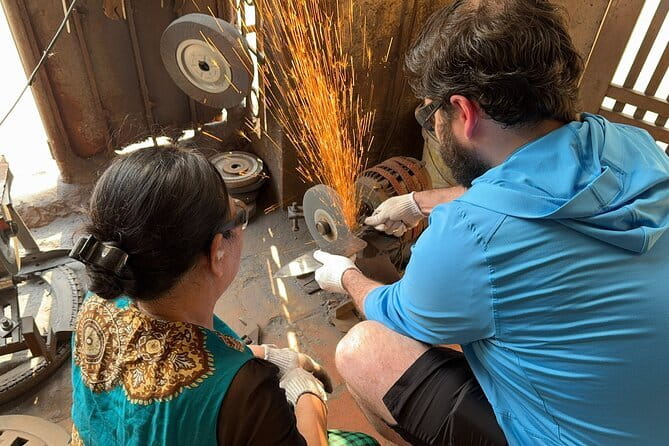
- Traditional methods with practical help: Use hammers, cutters, an anvil, a forge, a hydraulic machine, and a grindstone.
- A small group format: The class accepts no more than 10 people, giving you a better chance to receive direct help.
- A useful souvenir: Take home a handmade knife that carries your own design and work.
Why Da Sy makes this more than a craft class
The best part of this experience is the setting. Da Sy, in Hanoi’s Ha Dong area, is known for generations of blacksmithing. The village once supplied weaponry during Vietnam’s wars, while its workshops now produce knives and other useful metal goods.
That background matters because you are not simply attending a themed activity made for tourists. You are working in a place where forging is part of local life. The class gives you a direct look at how a practical village trade survives, including the patience and physical skill needed to keep it going.
I also like the scale of the operation. The maximum group size is 10, and the work takes place at the artisan’s house. That should feel more personal than a large production class, though your exact amount of one-to-one time can depend on the group and the stage of the work.
The class runs for about two hours and 30 minutes. That is enough time to complete the main stages without turning the activity into a full-day commitment. You will still need to stay focused. Metalwork rewards care, and the final blade depends on the small choices you make along the way.
More hands-on classes and workshops in Hanoi:
- Hanoi Cooking Class: Culture, Local Market & Meaning CSR Impact
★ 5.0 · 5,147 reviews - 5 Traditional Dishes Hanoi Cooking Class with Market Trip
★ 5.0 · 4,890 reviews - Hanoi Coffee Workshop: Taste Salt, Coconut and Egg Coffee
★ 5.0 · 1,286 reviews
Starting with a blade design
Your first task is to sketch the knife you want to make on a selected piece of durable metal. This is where the finished object begins to feel personal. You are not just picking a souvenir from a shelf. You are deciding what the blade should look like and how it should function.
The design stage also gives the artisan a chance to guide you toward a workable shape. Beginners may arrive with a vague idea, while others may already know what kind of kitchen or utility knife they want. The class description makes clear that you choose the knife design and customize parts such as the blade and handle.
I would take this step seriously. A simple shape is likely easier to finish neatly than an overly ambitious one, especially if you have never worked with metal. The point is not to prove how complicated a blade you can draw. It is to create something you can actually complete and use.
Cutting and heating the steel
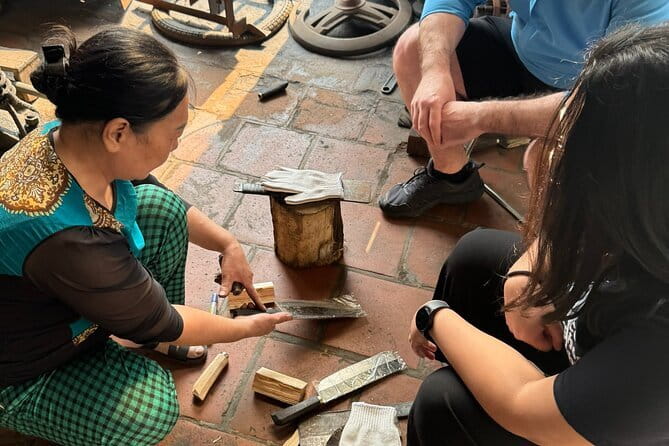
After the design comes the physical work. You cut out the blade and tang, the narrow part that fits into the handle, using traditional tools such as cutters, hammers, and an anvil. The metal then goes into the forge to heat up for shaping.
This is the moment when the class shifts from sketching to real workshop work. You will not simply watch an artisan perform the difficult parts. You take part, with step-by-step help and safety equipment provided at the house.
The role of the artisan is important here. Tuyen’s long experience means she can demonstrate how the tools work and help you avoid common beginner mistakes. The experience is designed for people without blacksmithing experience, but you still need to follow instructions closely around hot metal and heavy tools.
The class description says all necessary safety equipment is included. That removes one practical worry, but you should still wear sensible clothing and shoes suitable for a workshop. The supplied information does not specify a dress code, so I would avoid anything you would not want near heat, dust, or metal filings.
Hammering the blade into shape
Once the metal is hot, you take turns hammering it into the shape of your design. This is the most physical section of the class and the point where you feel the craft rather than simply hear about it.
The hammering takes patience. You may need several passes to bring the metal closer to the desired form. An artisan works alongside you, correcting the angle and helping you see where the blade needs more attention. A hydraulic machine is then used to refine rough edges and smooth out parts of the shape.
That combination is useful. Traditional hand tools let you take part in the old method, while the hydraulic machine helps the finished knife reach a cleaner standard. You are not left with every rough mark produced by a first attempt, but you also do not hand over the whole process to a machine.
I would not book this expecting a relaxed hour of light activity. One person described it as more active than a typical jewelry-making class, which is a fair way to think about it. The reward is that you can point to the blade and say you helped forge it, rather than only choosing its color or decoration.
Something completely different for the rest of your time in Hanoi:
- Hanoi Jeep Tour: Food, Culture and Fun by Vietnam Army Jeep
★ 5.0 · 15,222 reviews - Full-Day Ninh Binh Highlights Tour from Hanoi
★ 5.0 · 7,761 reviews - Hanoi: Ha Long Bay Day Cruise – Swimming, Meal, Kayaking
★ 4.7 · 7,415 reviews - Hanoi: Water Puppet Show Tickets
★ 4.6 · 7,029 reviews
Carving the handle and making the knife yours
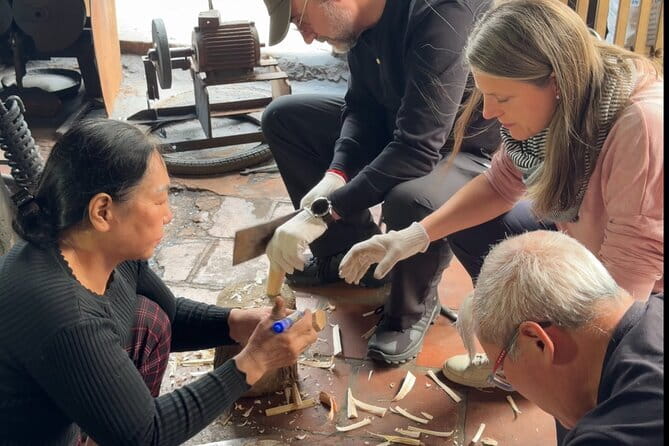
The handle gives the knife another personal touch. The process can begin with a block of wood, including bark, which you shape into a grip for the finished blade. You may carve and refine it as part of the class, depending on the exact knife format being made.
This is one of the most appealing parts for anyone who wants a souvenir with a strong sense of place. The blade connects you to Da Sy’s metalworking tradition, while the handle shows your own handwork. Small uneven spots are not necessarily flaws. They are evidence that a person made the object.
The available information does not list a menu of handle woods, colors, or decorative options, so you should not assume a large selection. What you can expect is the chance to customize the handle and blade within the materials and tools available at the workshop.
Guides help make this part easier to follow. Mint has worked as an interpreter for the class, while Nick and Tulip have also guided visitors through the process. The guide assigned to your session may differ, but the format includes explanation as well as practical help.
Grinding, honing, and the tar-based sharpening method
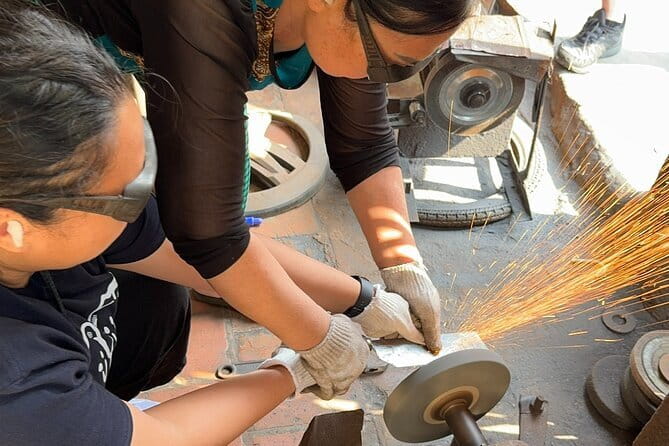
The final stages involve grinding, honing, and sharpening the blade. You use a grindstone to create a usable edge, with the artisan helping you control the angle and refine the result.
This part can look simple until you try it. A knife edge depends on steady movement and attention. If you rush, you may create an uneven edge. If you follow the artisan’s instructions, you get a clearer sense of how a working blacksmith brings a raw piece of metal to a practical finish.
One especially unusual detail is the tar-based wash used during sharpening. It is described as an old family technique passed through generations. You do not just get a standard sharpening demonstration. You see a local method that is closely tied to the family’s way of making knives.
The class finishes with a handmade knife you can take home. It is intended to be functional, not merely decorative, though the precise final size depends on the design you make. One participant made a knife about 14 centimeters long and noted the importance of checking home-country airport rules before flying with it.
The people who shape the experience
The artisan is the central figure here. Tuyen is presented as the only officially recognized female artisan in the trade and has devoted 44 years to preserving it. That gives the class a strong human focus. You are learning a technical skill from someone whose working life is tied to the survival of the craft.
The guides matter, too. Mint is described as personable and helpful during interpretation. Nick has also provided local food suggestions around Hanoi, which can be useful if you schedule this class near the end of your stay and want ideas for your remaining meals. Tulip has guided the class and explained each stage clearly.
Guide assignments can change, so I would not book solely for a particular name. The important point is that the class has an interpreter or guide who can help connect the artisan’s demonstration with your own work.
The strongest praise for this activity focuses on patience, encouragement, and support for beginners. That is exactly what you want in a class where a poor first hammer blow or uneven sharpening stroke is part of learning.
Is $45.51 a fair price?
At $45.51 per person, I see good value if you want an activity rather than another sightseeing stop. The fee covers the instruction, workshop use, tools, and safety equipment, plus a knife you helped create. You are paying for time with a working artisan and for the materials needed to complete the project.
The value is less obvious if you only want a cheap souvenir. A factory-made knife will cost less and require no effort. This class makes sense because the object carries the memory of designing, hammering, shaping, and sharpening it yourself.
The maximum of 10 people also helps justify the price. It is not a guaranteed private lesson, but the group is small enough for direct guidance to be part of the experience. A private class with a car has also been arranged by some customers, but private transport is not listed as a standard inclusion, so confirm that arrangement before booking.
Gratuities are optional and not included. The activity is mobile-ticketed, and the meeting point is at Da Sy, Kien Hung, Ha Dong, Hanoi. Since the class ends where it begins, plan your route carefully and allow enough time to reach the village.
Who should book this class?
I would recommend it to you if you like practical activities, local trades, food-related tools, or souvenirs with a story. It also suits repeat visitors who have already seen Hanoi’s main sights and want something more hands-on.
Families and couples may enjoy making one knife together, since the finished item can be shared. One booking can also be used when only one person wants to make a knife, according to the available booking experience, but confirm the current rules if several people plan to attend and share one finished item.
This is also a strong choice for anyone curious about women’s roles in traditional craft. Tuyen’s position gives the class a different angle from a standard blacksmith demonstration.
I would think twice if you dislike heat, hammering, workshop noise, or close attention to safety instructions. The activity is not passive. You will need to work with tools and take part in each stage.
Practical details before you go
The activity lasts about two hours and 30 minutes and accepts a maximum of 10 participants. The meeting point is Đa Sỹ, Kiến Hưng, Hà Đông, Hà Nội, and the activity returns there at the end.
Confirmation is provided when you book. Service animals are allowed, and the meeting point is near public transportation. Most people can participate, but the experience still involves physical workshop tasks, so consider your comfort with standing, hammering, and handling tools.
The cancellation policy is generous if your plans change early. Cancel at least 24 hours before the local start time for a full refund. Cancellations or changes made inside that 24-hour window are not accepted for a refund.
Plan your flight home with care. A knife is included as the finished product, but rules for carrying or checking blades vary by country. Check your airline and home-country regulations before you commit to a larger blade or pack the finished knife in your luggage.
Should you book the Hanoi knife-making class?
I would book this if you want a genuine local craft experience and like the idea of taking home something you helped make from raw materials. The combination of Da Sy’s blacksmithing tradition, Tuyen’s long career, small-group instruction, and the unusual sharpening method gives the class more substance than a basic souvenir workshop.
You should skip it if you want a quiet, polished activity with little physical effort. For everyone else, $45.51 is a sensible price for two and a half hours of instruction, tools, safety equipment, and a functional handmade knife. Book early enough to protect the free-cancellation window, and check your country’s rules for bringing blades home.
FAQ
Where does the knife-making class take place?
The class takes place at an artisan’s house in Da Sy, Kien Hung, Ha Dong, Hanoi, Vietnam. It ends back at the same meeting point.
How long does the experience last?
The class lasts approximately two hours and 30 minutes.
How many people can join?
The activity has a maximum group size of 10 participants.
Is safety equipment provided?
Yes. The artisan’s house provides all tools and the necessary safety equipment for knife making.
Can I cancel for a full refund?
Yes, if you cancel at least 24 hours before the experience start time. Cancellations or changes made less than 24 hours before the start time are not refunded.
Is transportation included?
The meeting point is in Da Sy, and transport is not listed among the inclusions. A private class with a car has been arranged separately, but you should confirm any private transport details before booking.
Just added to the Hanoi list
- (TOP) Private car: Hanoi/Noi Bai Airport (HAN) from/to Ninh Binh★ 3.5 · 16 reviews
- Thang Long Water Puppet Theater★ 4.5 · 45 reviews
- Private car transfer from Hanoi Airport to Hotels★ 4.5 · 5 reviews
- Private Tour Ninh Binh 1 Day★ 5.0 · 5 reviews
- Private Hanoi Old Quarter Food Tour with 8+ Authentic Tastings★ 5.0 · 11 reviews
- Private Transfer Service from Hanoi to Ha Long Bay★ 5.0 · 3 reviews
- Private Transfer Between Hanoi City and Noi Bai Airport (HAN)★ 5.0 · 3 reviews
- Private Hanoi Food Walking Tour of the French Quarter★ 5.0 · 38 reviews
Workshops, compared.

Hanoi Cooking Class: Culture, Local Market & Meaning CSR Impact
Read our review →
5 Traditional Dishes Hanoi Cooking Class with Market Trip
Read our review →
Hanoi Coffee Workshop: Taste Salt, Coconut and Egg Coffee
Read our review →
Salt Coffee Workshop Awake Your Senses With 6 Brews
Read our review →
Vietnamese Food Cooking Class in Hanoi with Market Experience
Read our review →
Handcrafted Wood Carving Workshop with Local Artisan
Read our review →
5 Local Dishes Cooking Class with Meal & Market Visit
Read our review →
Hanoi Cooking Class and Market Tour in Ancient House
Read our review →Browse the lists this tour appears in