
Reviewed · FULL-DAY
Full-Day Hop On Hop Off Bus Tour in Hanoi
Hanoi’s hop-on hop-off bus gives you a quick way to connect the city’s big sights, from St. Joseph’s Cathedral and Hoa Lo Prison to the Ho Chi Minh complex and Tran Quoc Pagoda. For a first day, I like the broad route and the freedom to get off whenever a museum or temple catches your eye.
I also like that the ticket includes air-conditioning, WiFi, a city map, bottled water, and rain protection. The main catch is reliability: traffic can slow the buses, stops may be hard to identify, and audio may not always match what you are seeing.
Key points at a glance
- Fourteen stops cover Hanoi’s major sights, including the Old Quarter, Ba Dinh Square, the Imperial Citadel, and the Opera House.
- A one-day ticket costs $20, which is useful if you plan to visit several paid attractions and make repeated bus rides.
- Entrance fees are separate, with listed prices ranging from 5,000 to 40,000 Vietnamese dong.
- The route can change on weekends, and traffic or road closures may cause delays.
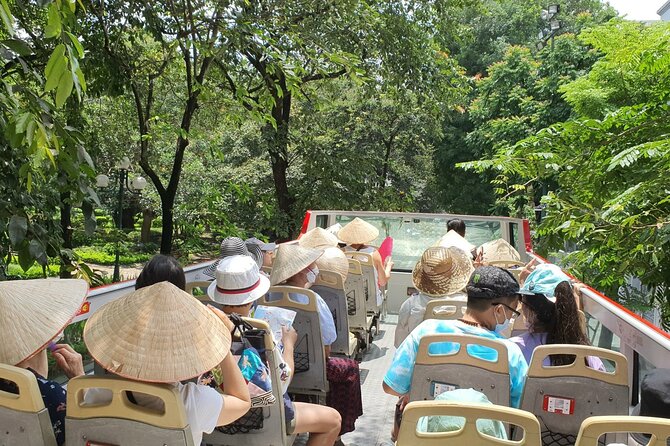
- The bus includes practical extras, such as WiFi, a map, water, a conical hat, and a raincoat.
- The best use is orientation, not a tightly timed sightseeing schedule.
Why this bus works well on a first day in Hanoi

Hanoi can feel confusing at first. The Old Quarter has narrow streets, constant movement, and attractions spread across several districts. A hop-on hop-off bus gives you a simple first look before you decide where to spend more time.
The route links French colonial buildings, old temples, wartime sites, museums, and important national monuments. You can ride the full circuit to get your bearings, then get off at two or three places that fit your interests.
I would not treat this as a private guided tour. It is transport with sightseeing value. The audio commentary adds context, but it may not always line up perfectly with the bus location. That means you should use the ride to see the city and save the detailed learning for the stops themselves.
The $20 price is reasonable if you use the bus for several rides and visit multiple attractions. It is less attractive if you simply stay on board for one circuit or need precise transport at a fixed time.
More full-day trips from Hanoi:
- Full-Day Ninh Binh Highlights Tour from Hanoi
★ 5.0 · 7,761 reviews - Ninh Binh Full-Day Tour from Hanoi to Hoa Lu, Tam Coc & Mua Cave Via Boat & Bike
★ 5.0 · 4,384 reviews - Ninh Binh Heritage Full Day Tour with Buffet Lunch and Limousine
★ 5.0 · 2,692 reviews
Starting at Dong King Nghia Thuc Square
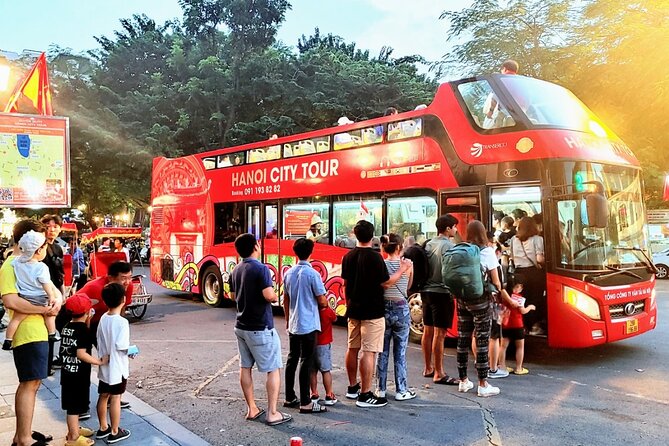
The ticket box and meeting point are at No. 7 Dinh Tien Hoang, near Dong King Nghia Thuc Square. This location puts you close to Hanoi’s famous lake district and within easy reach of the Old Quarter.
Bring your mobile ticket, but allow extra time for verification. The booking check can take longer than expected, especially when the reservation was made through a third-party booking platform. This is a small but important point: do not arrive at the last minute if you have a museum booking or a set plan afterward.
The operator provides a city map, which is useful for matching bus stops with nearby sights. Still, you should confirm the stop name and direction before getting off. Stop locations can be confusing, and two buses have reportedly passed a stop without picking up waiting passengers.
St. Joseph’s Cathedral and Hanoi’s French character
St. Joseph’s Cathedral is one of the easiest stops for a short visit. Built in 1884 and opened in 1886, it has a Gothic appearance influenced by Notre Dame in Paris. It is recognized as Hanoi’s oldest church.
There is no entrance fee, so this is a good early stop if you want to stretch your legs without adding to your budget. The cathedral also gives you a quick look at the French colonial layer of Hanoi, which feels very different from the nearby temples and old Vietnamese houses.
I would allow a short visit here rather than planning a long stop. The real value is its location and architecture, not a full-day museum experience.
Military history and the Flag Tower

The Vietnam Military History Museum stop includes access to one of Hanoi’s best-known historic landmarks, the Flag Tower. The tower survived the French colonial period, when much of the Hanoi Citadel was destroyed or altered, and it has become a symbol of the city.
The listed entrance fee for the Hanoi Flag Tower is 30,000 Vietnamese dong. Check the exact admission arrangement when you arrive, since the tower and museum references may not always be presented in the same way at the stop.
This is a useful stop for anyone interested in Vietnam’s military past. If that subject is not a priority, you might prefer a short look at the exterior and save time for the Imperial Citadel or Hoa Lo Prison.
Something completely different for the rest of your time in Hanoi:
- Hanoi Jeep Tour: Food, Culture and Fun by Vietnam Army Jeep
★ 5.0 · 15,222 reviews - Hanoi: Ha Long Bay Day Cruise – Swimming, Meal, Kayaking
★ 4.7 · 7,415 reviews - Hanoi: Water Puppet Show Tickets
★ 4.6 · 7,029 reviews - Hanoi Motorbike Tour: Food, Culture and Fun by Vintage Motorbike
★ 5.0 · 6,699 reviews
Ho Chi Minh’s Mausoleum and One Pillar Pagoda

The Ho Chi Minh Mausoleum sits in Ba Dinh Square, the place where Ho Chi Minh read Vietnam’s Declaration of Independence on September 2, 1945. The building is an important national site, and the square gives you a sense of the ceremony attached to modern Vietnamese history.
The listed entrance fee is 25,000 Vietnamese dong. Plan carefully, since this area may require more time than a quick photo stop, and the route can be affected by traffic or official activity.
Nearby, the One Pillar Pagoda offers a very different experience. The small temple rests on a single pillar and traces its original construction to 1049, with later additions completed in 1105. There is no entrance fee listed for the pagoda.
I like these two stops together because they show two sides of Hanoi: twentieth-century national history and older religious architecture. You do not need to spend long at the pagoda, but its unusual design makes it worth getting off the bus.
Tran Quoc Pagoda beside West Lake
Tran Quoc Pagoda is described as Hanoi’s oldest pagoda, with origins in the sixth century. Its long history gives it special importance, but the setting also matters. The pagoda sits by the water, away from the tighter streets of the Old Quarter.
The listed admission fee is 5,000 Vietnamese dong, making it one of the least expensive paid stops. It is a good place to pause, especially if you want a quieter setting after visiting central Hanoi.
Allow enough time to walk from the bus stop if the vehicle cannot stop directly beside the entrance. One practical warning applies across the whole route: a stop name does not always mean the bus drops you at the exact door of the attraction.
The Cua Bac Church route detail
The itinerary lists Stop 7 as Công viên Yên Sở, but the attraction description refers to Cua Bac Church. That mismatch is worth noting before you plan your day.
Cua Bac Church was built in 1932 under the French administration of Indochina and is one of Hanoi’s three major churches, along with St. Joseph’s Cathedral and Ham Long Church. Its design is connected to the French urban plan overseen by Ernest Hébrard.
If this church is important to you, confirm the current stop name and location with the operator before setting out. Route information can change, and this is exactly the sort of detail that can lead to a wasted walk or a missed bus.
Quan Thanh Temple and the Four Sacred Temples
Quan Thanh Temple dates to the reign of Emperor Ly Thai To, from 1010 to 1028. It is dedicated to Tran Vu, the Taoist deity of the North, whose symbols include the serpent and turtle.
The temple is one of four sacred temples traditionally placed in the four directions to protect the capital from harmful spirits. The listed admission fee is 10,000 Vietnamese dong.
This stop adds religious and symbolic context that you will not get from the colonial buildings or national monuments. It is also a good reminder that Hanoi’s story is not only political. Local spiritual traditions have shaped the city for centuries.
Imperial Citadel of Thang Long

The Imperial Citadel of Thang Long was built in the eleventh century by the Ly Viet Dynasty and marked the independence of Dai Viet. It was built over the remains of a Chinese fortress dating from the seventh century, on land reclaimed from the Red River Delta.
The listed entrance fee is 30,000 Vietnamese dong. This is one of the stops where I would spend real time rather than making a quick visit. The site helps connect Hanoi’s ancient past with the city you see today.
Because the bus route may be delayed by traffic, check the final bus time before entering. A long visit can be rewarding, but you do not want to leave the citadel and discover that the next bus is far behind schedule.
Temple of Literature and Vietnam’s first university
The Temple of Literature was built in 1070 under Emperor Ly Thanh Tong and is dedicated to Confucius, sages, and scholars. It also housed the Imperial Academy, described as Vietnam’s first national university.
The listed entrance fee is 30,000 Vietnamese dong. This is one of Hanoi’s most worthwhile stops if you want to understand the importance of education and Confucian thought in Vietnamese culture.
The temple complex gives you a calmer, more deliberate experience than a ride through the city streets. I would pair it with the Imperial Citadel if you are interested in architecture, history, and the development of Hanoi as a political center.
Hoa Lo Prison and the Vietnamese Women’s Museum
Hoa Lo Prison was first used by French colonists for political prisoners and later by North Vietnam for American prisoners of war. The remaining gatehouse now serves as a museum, and the prison is often known by its wartime nickname, the Hanoi Hilton.
The listed admission fee is 30,000 Vietnamese dong. This stop presents difficult history, so give yourself time to read the displays rather than rushing through simply to catch the next bus.
The Vietnamese Women’s Museum offers a different subject. Operated by the Vietnam Women’s Union, it opened to the public in 1995 and holds more than 40,000 materials and artifacts connected with Vietnamese women. Its permanent and special exhibitions also address social change, vulnerable women, and disadvantaged children.
Admission is listed at 40,000 Vietnamese dong. If you only have time for a few museums, choose based on your interests. Hoa Lo focuses on imprisonment and political conflict, while the Women’s Museum gives you a wider view of family life, work, culture, and social change.
Hanoi Opera House and the Post Office by the lake
The Hanoi Opera House was built between 1901 and 1911 by the French colonial administration. Its design reflects the grand European style used for major civic buildings in French Indochina.
The final stop, at 75 Dinh Tien Hoang, is near the Hanoi Post Office. The post office is more than a century old and was designed by Henri Vildieu between 1894 and 1899. Its neoclassical style and lakeside location make it a pleasant place to finish the circuit.
These two stops work well for a final look at Hanoi’s colonial architecture. They also return you toward the central lake area, where you can continue on foot if the bus has finished for the day.
What the $20 ticket really includes
The ticket includes an air-conditioned vehicle, onboard WiFi, passenger insurance, a city map, bottled water, a conical hat, and a raincoat. Those small extras matter in Hanoi, where heat, sudden rain, and long walks can quickly change your mood.
The operator is also trying to reduce single-use plastic by providing a 20-liter water container for refills. Bring your own reusable bottle. Paper cups are available, but a bottle is more practical during a full day out.
Food and drinks beyond the supplied water are not included. Hotel pickup, airport transfers, gratuities, and attraction admissions are also separate.
If you visit the Flag Tower, Mausoleum, Tran Quoc Pagoda, Quan Thanh Temple, Imperial Citadel, Temple of Literature, Hoa Lo Prison, and Women’s Museum, the listed admission fees add up to 200,000 Vietnamese dong. That is still modest, but you should include it in your daily budget.
Timing, traffic, and the real bus experience
The ticket is described as lasting one day, and the route can be used for repeated rides during that period. On weekends, the route may change slightly. Traffic, public holidays, weather, and road closures can also lead to delays, fewer buses, or route changes.
This is not the right choice if you need exact departure times. One bus was reported to arrive more than 20 minutes late, and the condition of the vehicles has not always been consistent. Some buses have had broken windows or dirty interiors, while another bus had audio equipment that did not work.
At its best, the bus is clean, comfortable, and supported by useful audio commentary. At its worst, service gaps can cost you hours. I would keep your schedule flexible and avoid pairing the tour with a nonrefundable timed ticket.
Who should book this Hanoi bus tour?
I would recommend it to you if this is your first visit to Hanoi, you have only a day or two, or you want an easy overview before exploring on foot. It is especially useful for combining sights that are too spread out to cover comfortably by walking alone.
It also suits you if you like choosing your own stops. You can stay on board for an overview, then get off at the Temple of Literature, Hoa Lo Prison, Tran Quoc Pagoda, or the Ho Chi Minh complex.
I would hesitate if you expect a polished, perfectly timed operation. The mixed score of 3.8 from 12 ratings reflects that the concept works better than the execution can. The onboard staff may be helpful and the commentary interesting, but stop markings, audio timing, vehicle condition, and frequency can vary.
Should you book it?
Book this tour if you value coverage and flexibility more than strict timing. The route reaches a useful set of Hanoi landmarks, the $20 fare includes several practical extras, and the ride can save your energy during a hot or rainy day.
Skip it if you have only one must-see attraction, need a guaranteed departure time, or prefer a focused walking tour with a guide. For most first-time visitors, I would use the bus early in the visit, get off at two or three priority stops, and keep the rest of the day open in case Hanoi traffic has other plans.
FAQ
How much does the Hanoi hop-on hop-off bus tour cost?
The tour costs $20 per person for approximately one day of hop-on hop-off service.
Where does the tour begin?
The ticket box and meeting point are at Dong King Nghia Thuc Square, No. 7 Dinh Tien Hoang.
What is included in the ticket?
The ticket includes an air-conditioned vehicle, onboard WiFi, all taxes and fees, passenger insurance, a city map, bottled water, a conical hat, and a raincoat.
Are attraction entrance fees included?
No. Entrance fees are paid separately. Listed prices include 30,000 Vietnamese dong for the Flag Tower, 25,000 for the Ho Chi Minh Mausoleum, 5,000 for Tran Quoc Pagoda, and 10,000 for Quan Thanh Temple.
Is hotel pickup included?
No. Hotel pickup and drop-off are not included. Airport pickup and drop-off are also not included.
Can I bring my own water bottle?
Yes. The operator provides a 20-liter water container for refills and paper cups. Bringing a reusable bottle is encouraged to reduce plastic waste.
Can the route change?
Yes. The route and schedule may change because of traffic, public holidays, weather, road closures, and other unexpected conditions. The route may also change slightly on weekends.
Is the tour available in English?
Yes. The experience is offered in English and includes audio commentary.
What is the cancellation policy?
You can cancel up to 24 hours before the experience start time for a full refund. Cancellations or changes made less than 24 hours before the start time are not accepted for a refund. If poor weather causes the tour to be canceled, you will be offered another date or a full refund.
Just added to the Hanoi list
- Private car transfer from Hanoi Airport to Hotels★ 4.5 · 5 reviews
- (TOP) Private car: Hanoi/Noi Bai Airport (HAN) from/to Ninh Binh★ 3.5 · 16 reviews
- Thang Long Water Puppet Theater★ 4.5 · 45 reviews
- Private Tour Ninh Binh 1 Day★ 5.0 · 5 reviews
- Private Hanoi Old Quarter Food Tour with 8+ Authentic Tastings★ 5.0 · 11 reviews
- Private Transfer Service from Hanoi to Ha Long Bay★ 5.0 · 3 reviews
- Private Transfer Between Hanoi City and Noi Bai Airport (HAN)★ 5.0 · 3 reviews
- Ba Be National Park With Boat Trip, Kayaking, Swimming, Trekking And Cycling★ 5.0 · 10 reviews
Full-Day, compared.

Full-Day Ninh Binh Highlights Tour from Hanoi
Read our review →
Ninh Binh Full-Day Tour from Hanoi to Hoa Lu, Tam Coc & Mua Cave Via Boat & Bike
Read our review →
Ninh Binh Heritage Full Day Tour with Buffet Lunch and Limousine
Read our review →
Ninh Binh Full-Day Small Group of 9 Guided Tour from Hanoi
Read our review →
Lan Ha Bay full-day tour from Hanoi, Hai Phong – Serenity Cruises
Read our review →
Halong Bay Full Day with Kayaking, Hiking viewpoint, Cave – Deluxe To Luxury
Read our review →
Halong Bay Full Day With Cave, Kayaking And Swimming – Highway Transfer
Read our review →