
Reviewed · INCENSE AND CONICAL HAT VILLAGE TOURS
Hanoi: Rattan & Shoe Village or Incense Village, Hat Village
The most memorable part of this Hanoi outing is seeing ordinary craft work up close. In Chuong, you paint a Vietnamese conical hat. At Quang Phu Cau, you watch incense move from raw materials to finished bundles, with the bright drying yards making an especially good photo stop. The tour also offers a private route through leather shoe and rattan villages, giving you a look at work that supports thousands of local jobs.
I like the hands-on souvenirs, since you do more than walk through a workshop. I also like the human scale: family businesses, manual workers, and modern machines share the same story. The main consideration is choosing the right option, because the hat and incense route is not the same as the private shoe and rattan route, and the six-hour schedule can feel busy if you want a slow village visit.
Key points to know before booking
- Paint a real conical hat: Chuong Village gives you a free hat to decorate and take home.
- See incense made at two levels: Visit a family-scale workshop in Quang Phu Cau, then a nearby factory to compare methods.
- Choose between two craft routes: The group option focuses on hats and incense, while the private option visits shoe and Guot weaving workshops.
- Connect crafts with local income: Phu Yen’s footwear trade supports more than 2,000 employees, while Phu Tuc weaving provides steady work for villagers.
- Expect a six-hour outing: Pickup and drop-off are available in Hanoi’s Old Quarter, with morning and afternoon departures for the main group route.
- Bring room for small souvenirs: You receive a painted hat and incense items, while other workshop products may be available for personal purchase.
Why these villages make a better Hanoi day trip

Hanoi has plenty of historic buildings and food tours. This excursion takes you outside the city to see how rural workshops still earn their place in modern Vietnam. The crafts are not presented as frozen museum pieces. They are working businesses, shaped by family knowledge, new machinery, changing demand, and the need to provide dependable wages.
That matters because you see the connection between a handmade product and the people who produce it. In Phu Yen, about 300 households take part in leather and footwear work, and 35 households supply materials to the wider commune. The trade employs more than 2,000 people. Workshop employees are reported to earn about 7 to 10 million dong per month, roughly $300 to $450.
The tour is priced at $14 per person, which is modest for a six-hour guided outing with transport from the Old Quarter, entrance fees, bottled water, and craft activities. The value is strongest if you want an organized visit without arranging rural transport yourself. Check the exact option before paying, since the advertised routes cover different villages and may have different arrangements for lunch and transport.
More incense and conical hat village trips:
- Incense Village, Hat Making & Lacquer Artisan Small Group Hanoi
★ 5.0 · 1,266 reviews - Incense Village, Conical Hat, Lacquer Art, SMALL GROUP From Hanoi
★ 5.0 · 1,170 reviews - Hanoi: Incense Village, Hat, and Lacquer Artisanal Tour
★ 4.6 · 1,005 reviews
The six-hour route from Hanoi’s Old Quarter
The main group outing offers morning and afternoon departures. The morning schedule runs approximately from 7:45 to 13:30, while the afternoon schedule runs around 11:45 to 17:30. Pickup and drop-off are available in the Hoan Kiem area, which keeps the start simple if you are staying near Hanoi’s Old Quarter.
A guide accompanies you throughout the selected route. English, Vietnamese, Chinese, French, German, Italian, and Spanish guiding are available. Private and small-group formats are offered, so you can choose between a lower-cost shared outing and a more personal visit.
The timing is useful for a short Hanoi stay. You can spend the first part of the day in the city and take the afternoon departure, or finish the villages by early afternoon and still have an evening in Hanoi. The schedule is fairly full, so keep your expectations realistic. This is a working craft tour with several stops, not a long, quiet country walk.
An optional Train Street visit is connected with the hat and incense route. Treat it as an extra possibility rather than the main reason to book. The village visits are the core of the experience.
Painting your own hat in Chuong Village

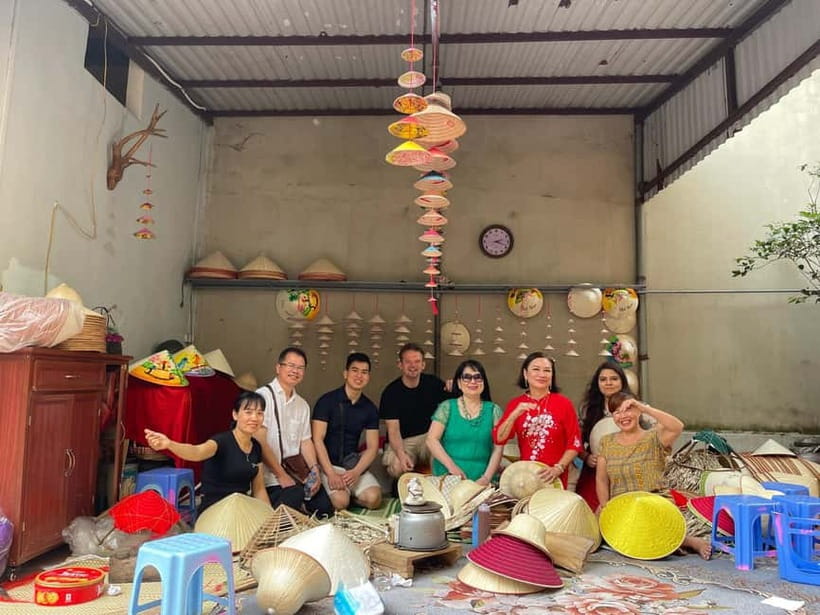
Chuong Village has made conical hats for more than 300 years. The hat, known in Vietnam as a non la, is one of the country’s most familiar symbols, but a finished souvenir tells you little about the work behind it. Here, you get to observe the process and then decorate a hat yourself.
The practical appeal is clear. You are given one free conical hat, paint it during the visit, and take it home. It is a more personal keepsake than a standard shop purchase, though you should not expect an elaborate art lesson. The activity is best viewed as a simple creative session that lets you leave with something connected to the village.
Look closely at the construction as your guide explains it. The craft depends on patient handwork and careful shaping. The village has kept this trade going for generations, yet it also operates as a living local industry. That combination is what makes the stop worthwhile.
The hat visit is a good match for families and for anyone who wants to take part rather than only take photographs. It also gives you a natural introduction to Vietnamese daily life before the incense stop, which is more focused on production and workshop observation.
Following incense from family workshop to factory
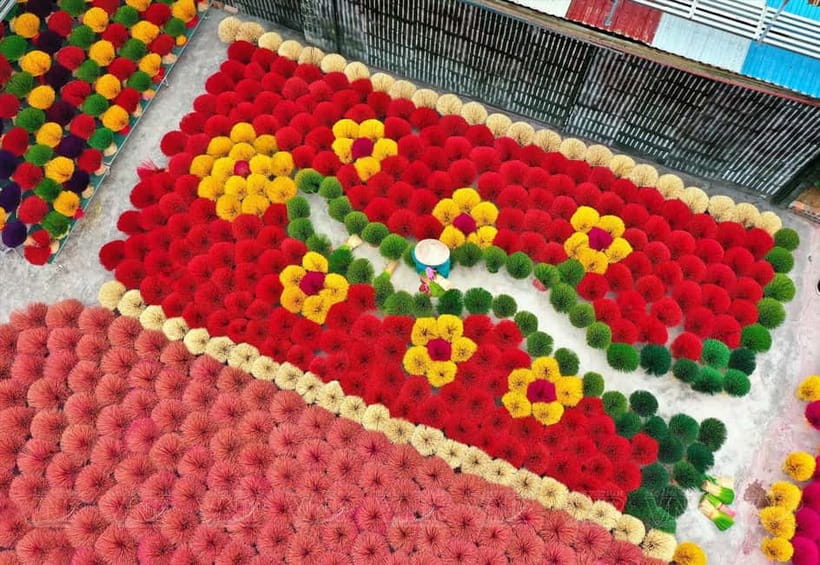
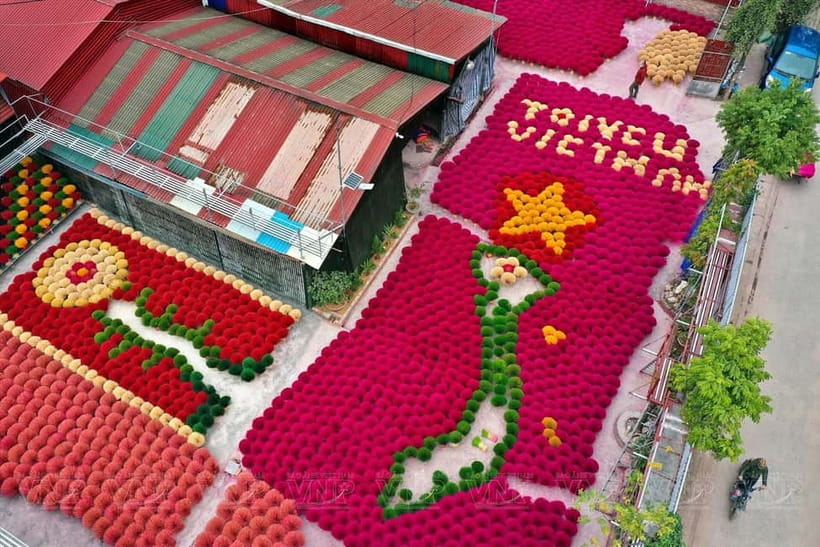
Quang Phu Cau has produced incense for more than 100 years. The visit takes you to the center of the village, where you see incense made on a family scale. You then continue to a nearby factory for a closer look at production from the beginning through the finished product.
This two-part arrangement is one of the strongest features of the outing. A small family workshop shows the personal side of the trade. The factory visit explains how larger production works and gives you a better sense of the manual labor involved. You are not simply shown a colorful display and sent on your way. You get a basic picture of how the industry functions.
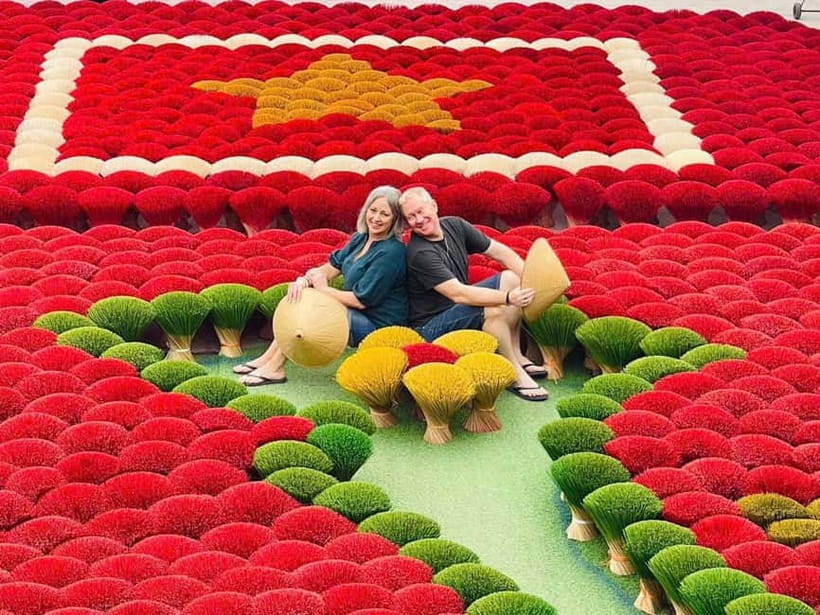
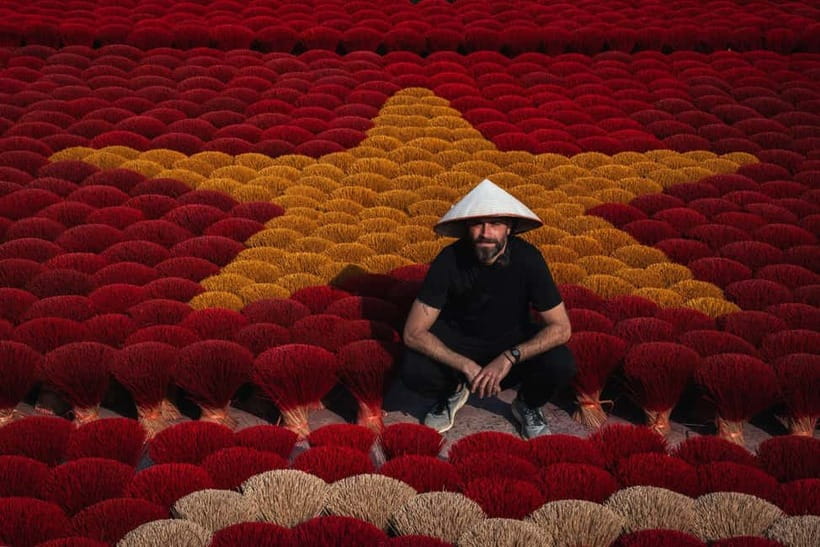
The drying areas are likely to be the most photogenic part of the stop, with incense arranged in large displays. Still, be respectful with your camera. These are working spaces, and people are carrying out paid jobs rather than posing for a staged village show.
You can also make incense yourself and receive some incense sticks afterward. That small activity gives the stop more meaning. Once you have handled the materials, you understand that the final bundles are the result of repeated, careful work.
If you are sensitive to strong scents, keep that in mind. The tour information does not specify how long you remain in production areas, but incense is central to the visit. You can ask the guide for practical advice during the stop.
Something completely different for the rest of your time in Hanoi:
- Hanoi Jeep Tour: Food, Culture and Fun by Vietnam Army Jeep
★ 5.0 · 15,222 reviews - Full-Day Ninh Binh Highlights Tour from Hanoi
★ 5.0 · 7,761 reviews - Hanoi: Ha Long Bay Day Cruise – Swimming, Meal, Kayaking
★ 4.7 · 7,415 reviews - Hanoi: Water Puppet Show Tickets
★ 4.6 · 7,029 reviews
The private Phu Yen shoe workshop
The private route changes the focus from decorative souvenirs to production and employment. At a workshop associated with Nguyen Thi Nhan’s family, you see how sandals are made and how the methods have changed over time.
The workshop once relied more heavily on manual work. Modern machines now replace many of those stages, while people still handle important parts of production. With 25 official employees, the workshop produces about 1,700 to 1,800 pairs of sandals each day. Those numbers help you understand the scale: this is not only a tiny artisan studio making one item at a time.
The leather and footwear craft in the area dates to the French colonial period. Nguyen Luong Mac, who had operated a workshop making boat-like shoes in Hai Phong, helped pass shoe-making skills to later generations. The trade has continued and adapted instead of disappearing.
I find this stop especially useful for anyone interested in how traditional work responds to modern business needs. You see a village craft that uses inherited skills, but you also see machinery, supply networks, and production targets. That is a more honest picture of local industry than a purely decorative craft demonstration.
The private option is likely the better choice if you care more about manufacturing and local employment than about painting a souvenir hat. It is also the route to choose if you want a more focused visit rather than the standard hat and incense schedule.
Phu Tuc and the old Guot weaving trade
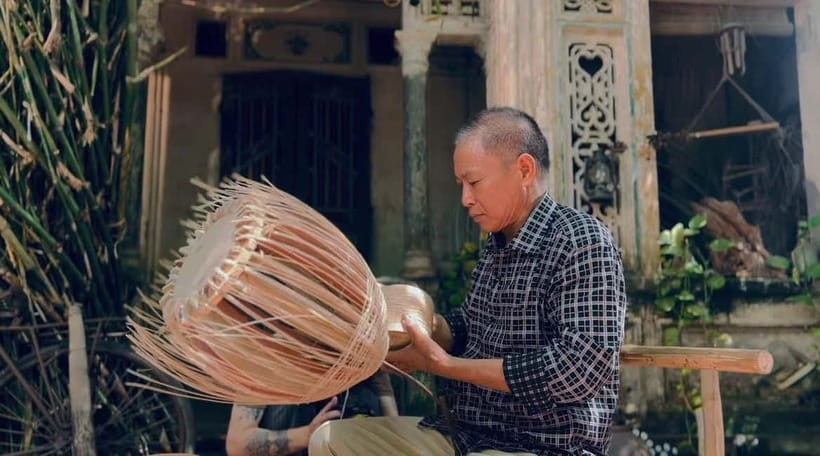
Phu Tuc Village has produced Guot plant goods since the 17th century. Guot is valued for its natural dark red or brown color, flexibility, and durability. Workers dry the plant in the sun, sort it by size and color, and weave it into useful household and decorative items.
You may see baskets, robes, tables, chairs, photo frames, flower vases, and animal figures. The variety shows how a simple plant can support a broad product range when local makers know how to prepare and shape it.
The tour includes a meeting with a family specializing in bamboo weaving, along with a look at Guot, bamboo, and rattan techniques. That family setting gives you a chance to ask questions about the materials and the work itself. The craft has evolved over time, and the village uses it to provide stable jobs and income.
The itinerary places lunch at Phu Tuc, though the included features specifically list transport, guiding, water, entrance fees, and craft visits rather than a clearly stated meal. Confirm the lunch arrangement when booking. This is a small but important detail, especially if you are choosing the private route and planning your day around the stop.
Phu Tuc suits visitors who like useful objects and traditional materials. The products are not just pretty displays. They show how local plant fibers become items for homes, shops, and gifts.
What the tour does well, and where it falls short
The strongest part of this experience is its access. You can see local work that is difficult to find on a normal Hanoi city visit, and the guide helps explain what you are looking at. Pickup is convenient, the route is structured, and entrance fees are covered.
The hands-on elements also matter. Painting a hat and making incense are simple activities, but they keep the visit from becoming a string of short photo stops. You return with a hat and incense items that have a clear connection to the places you visited.
The main weakness is the number of choices under one experience. The name covers a group hat and incense route, a private shoe and rattan route, and a one-hour local guide option at the incense village for people who already have a car. Read the selected route carefully. You do not want to book expecting the shoe workshop and arrive on a hat-focused schedule.
The six-hour duration is another consideration. You will cover several places and learn about multiple crafts, but you may not have long free periods in each village. If you want detailed shopping time, slow photography, or extended conversations with artisans, a private format should suit you better than a shared group outing.
A final practical point is the Lunar New Year surcharge. An additional 250,000 dong per person applies from February 16 to 19, 2026. Factor that into the price if your dates fall within that period.
Who will get the most from this outing
I would recommend the tour to you if you want a clear look at working craft villages without spending time arranging transport beyond Hanoi. It is particularly suitable for families, first-time visitors, photographers, and anyone who prefers seeing how goods are made rather than only shopping for them.
The standard half-day route works well if you want recognizable Vietnamese crafts. Chuong gives you the conical hat, while Quang Phu Cau provides the incense story, factory visit, and colorful production scenes.
Choose the private shoe and rattan route if you are interested in business, manufacturing, village employment, and natural materials. It offers a more serious look at how old trades survive by adjusting their tools and output.
The one-hour incense option suits you only if you already have a car and need a local guide. It does not include the full car transfer arrangement, and you pay the transport and entrance fees yourself.
The tour is wheelchair accessible, and live guiding is available in several languages. Free cancellation is available up to 24 hours before departure, and you can reserve now and pay later, which helps if your Hanoi schedule is still changing.
Should you book it?

Book this experience if you want direct contact with Vietnamese craft production and a practical half-day outside Hanoi. The $14 price is good value for the main group route, especially with pickup, guiding, entrance fees, a painted hat, and incense activities included.
Choose carefully between the routes. The hat and incense option is the best all-around introduction, while the private shoe and rattan visit is better for anyone curious about village economics and modern workshop methods. Skip it if you want a relaxed countryside day with lots of free time. This tour is structured, informative, and busy, with the greatest reward coming from paying attention to the people and processes behind the finished goods.
FAQ
How long does the main tour last?
The main group tour lasts about six hours. Morning departures run approximately from 7:45 to 13:30, and afternoon departures run from about 11:45 to 17:30.
Where does pickup take place?
Pickup and drop-off are available in the Hoan Kiem area of Hanoi’s Old Quarter.
Which villages are included in the half-day group option?
The half-day group option visits Chuong Conical Hat Village and Quang Phu Cau Incense Village. An optional Train Street visit may also be available.
Can I paint a conical hat?
Yes. The tour includes one free conical hat for you to paint in the hat village and take home as a personalized souvenir.
Can I make incense during the visit?
Yes. You can make incense sticks and receive some free incense afterward.
What is included in the private shoe and rattan option?
The private route includes a sandal production workshop in Phu Yen Village and a visit to Phu Tuc Village, where you can observe Guot, bamboo, and rattan weaving and meet a family specializing in bamboo weaving.
Is the tour available in languages other than English?
Yes. Guiding is available in Vietnamese, Chinese, French, German, Italian, and Spanish, as well as English.
Just added to the Hanoi list
- (TOP) Private car: Hanoi/Noi Bai Airport (HAN) from/to Ninh Binh★ 3.5 · 16 reviews
- Thang Long Water Puppet Theater★ 4.5 · 45 reviews
- Private car transfer from Hanoi Airport to Hotels★ 4.5 · 5 reviews
- Private Tour Ninh Binh 1 Day★ 5.0 · 5 reviews
- Private Hanoi Old Quarter Food Tour with 8+ Authentic Tastings★ 5.0 · 11 reviews
- Private Transfer Service from Hanoi to Ha Long Bay★ 5.0 · 3 reviews
- Private Transfer Between Hanoi City and Noi Bai Airport (HAN)★ 5.0 · 3 reviews
- Ba Be National Park With Boat Trip, Kayaking, Swimming, Trekking And Cycling★ 5.0 · 10 reviews
Incense and Conical Hat Village Tours, compared.
Incense Village, Hat Making & Lacquer Artisan Small Group Hanoi
Read our review →
Incense Village, Conical Hat, Lacquer Art, SMALL GROUP From Hanoi
Read our review →
Incense Village, Hat, and Lacquer Artisanal Tour
Read our review →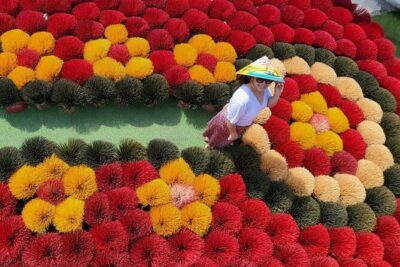
Incense Village Small Group of 9 Tour From Hanoi to Ninh Binh
Read our review →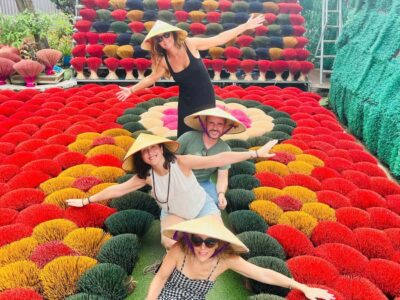
Incense Village, Hat, Lacquer Tour & City Highlights
Read our review →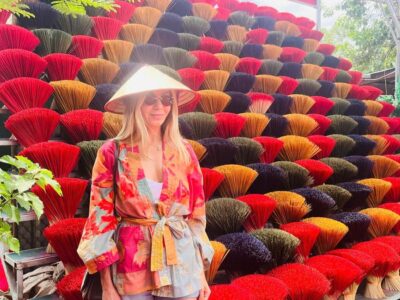
Incense Village, Hat, Lacquer, & City Highlights Tour
Read our review →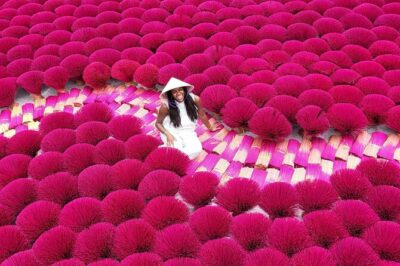
Instagram Incense Quang Phu Cau Village Tour with Train Street
Read our review →
INCENSE Villages & Ha Noi City Full Day guided Tour with Lunch
Read our review →Browse the lists this tour appears in