
Reviewed · HANOI WALKING TOURS
Hanoi Highlights and Hidden Gems Walking Tour
Hanoi reveals itself best on foot, where a market entrance, narrow lane, old church, and railway line can all fit into one morning. This three-hour walk connects major sights with lesser-known corners, giving you useful context instead of a quick photo stop.
I like the start at Dong Xuan Market, which puts you straight into Hanoi’s daily rhythm, and I like the finish at the Opera House, a fitting place to discuss the 1945 August Uprising. The main consideration is pace: nine stops in about three hours means you will often get a short explanation rather than a long visit.
- Dong Xuan Market begins the story with Hanoi’s wartime past and the old city’s trading life.
- Phung Hung Mural Street offers easy photo stops and a look at a Korean-Vietnamese cultural project.
- The railway section brings you close to local homes and one of Hanoi’s most photographed settings.
- St. Joseph’s Cathedral and Hoan Kiem Lake add major landmarks without losing the walking-tour feel.
- The group is capped at 15 people, making questions and conversation more practical than on a large city tour.
- The $15 price covers a useful orientation across central Hanoi, with no admission fees listed for the stops.
Why this three-hour walk works well in Hanoi
Hanoi can feel confusing when you first arrive. Streets change character quickly, traffic seems to come from every direction, and historic places are often tucked beside ordinary shops and homes. A guided walk gives you a framework for the city before you set out on your own.
This route is especially useful because it does not rely only on Hanoi’s headline sights. You will see the Old Quarter, but you will also follow a line through murals, railway tracks, colonial buildings, churches, lakeside monuments, and hotel history. That mix helps you understand Hanoi as a living city rather than a row of monuments.
The tour starts at 9:30 a.m. and lasts about three hours. That is a sensible length for Hanoi’s heat, traffic, and uneven sidewalks. You should still wear comfortable shoes, bring water, and expect to walk through busy streets and narrow passages.
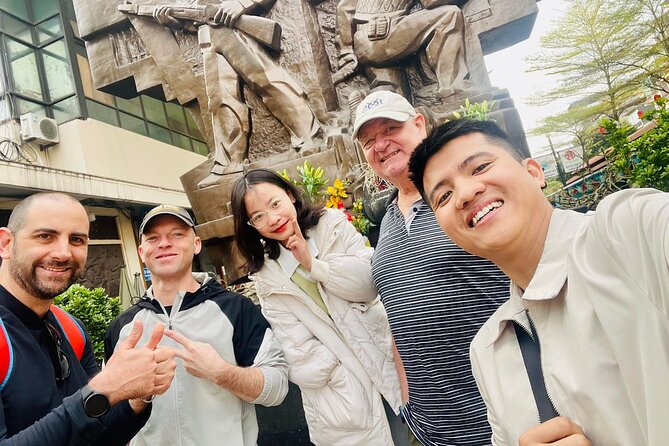
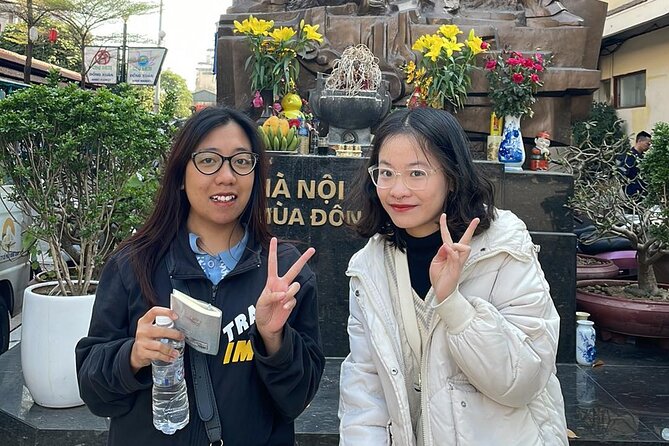
The maximum group size is 15. That is not a private tour, but it is small enough for a guide to keep the group together and answer questions. Son is specifically praised for flexibility and for showing places that are easy to miss. Mr. Vu is also described as informative, humorous, and strong on historical background.
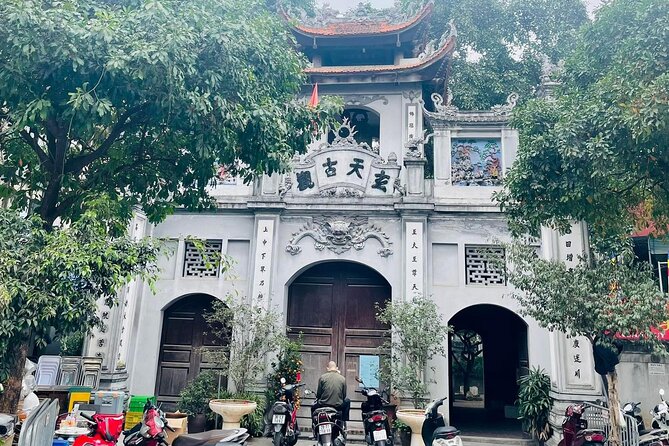
Starting at Dong Xuan Market and the Old Quarter
Dong Xuan Market is a strong meeting point because it immediately gives you a sense of Hanoi’s commercial heart. The opening section explains the city’s past and the battle of Hanoi, connecting the market area with the conflicts that shaped the capital.
You get about 20 minutes here. That is enough for an introduction and some orientation, but not enough for a full market exploration. If you want to shop, eat, or photograph every corner, plan to return later on your own.
I like this beginning because it avoids a slow start. You are not first gathering in a hotel lobby or waiting beside a single monument. You meet amid one of the Old Quarter’s key public places, then move into the city on foot.
The market also helps you understand the route’s approach. This is not simply a list of famous buildings. It uses ordinary parts of Hanoi to explain how the city functions, how its streets developed, and how history remains close to daily life.
More walking tours in Hanoi:
- [HOT] Hanoi Old Quarter Walking Street Food – Small Group Tour
★ 5.0 · 2,163 reviews - Private Walking Tour of Hanoi City
★ 5.0 · 1,251 reviews - Hanoi: Small-Group Street Food Walking Tour
★ 4.8 · 1,165 reviews
Phung Hung Mural Street and the city’s public art
The next stop is Phung Hung Mural Street, where painted panels run along an old urban structure. The murals were presented as a gift of friendship from the Korean government, and each section offers a different image connected with culture and local life.
You have roughly 20 minutes here. This is one of the easiest places on the route for photographs, so keep your phone ready, but listen to the explanation as well. The value is not only the wall itself. It is the way public art has been used to bring attention to a historic part of the city.
This stop also breaks up the older architectural material with something more modern. After hearing about battles and markets, you get a visual account of Hanoi’s cultural connections with another country.
Do not expect a major museum visit. The murals are an outdoor stop, and the experience depends on the guide’s explanation and the condition of the public space that day. Still, it adds variety and gives you a clear picture of how Hanoi mixes old buildings with newer cultural projects.
The railway tracks and the homes beside them
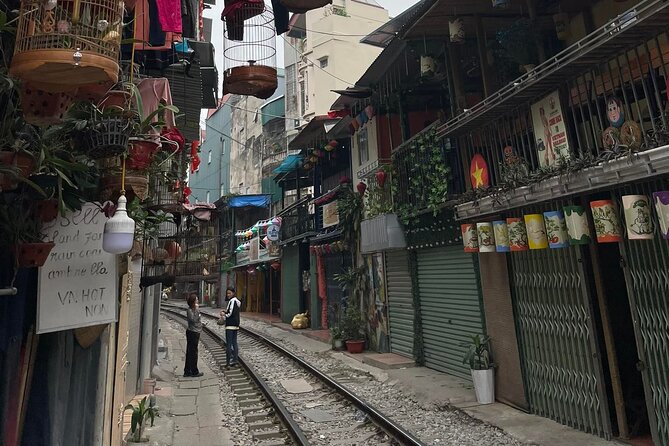
Duờng Tau, described as Hanoi’s famous railway setting, is one of the route’s most distinctive stops. Here you can see train tracks running close to local homes, a scene that has become one of the city’s best-known photo subjects.
The tour allows about 25 minutes, making this the longest stop on the route. That extra time matters. You can take photographs, watch the setting, and hear why the railway corridor has attracted so much attention.
The guide does not promise a train passing during your visit, so think of this as a chance to see the tracks and their unusual surroundings, not as a guaranteed train-viewing event. The route description specifically highlights the possibility of seeing a local train pass by, but railway timing is not stated.
I find this stop valuable because it shows a side of Hanoi that formal monuments cannot. The tracks sit beside the routines of ordinary homes, creating an unusual contrast between infrastructure and neighborhood life. It is also a good reminder to follow the guide’s instructions and stay aware of your surroundings near the railway.
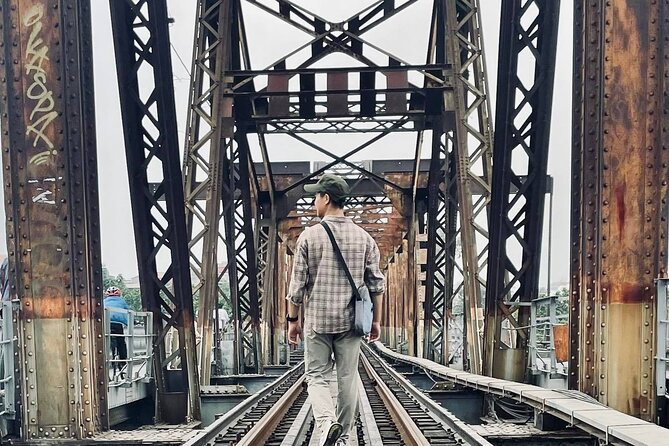
One review describes the walk as including the area around Long Bien’s old train station. If that section is part of your guide’s version of the route, it adds another useful link between Hanoi’s railway past and its present-day streets.
Huong Phung and French Indochina architecture
The stop listed as Huong Phung focuses on what is described as one of the best-preserved French Indochina buildings in the Old Quarter. You get about 15 minutes here, so the emphasis is on viewing the exterior and learning why the structure matters.
This is the sort of pause that can be easy to miss when walking alone. Hanoi has many old façades, but without context, they can blur together. A guide can point out the building’s period and explain how French colonial design became part of the city’s visual character.
The short time also keeps the tour moving. You are not spending the entire morning on one architectural site. Instead, this stop becomes a bridge between the railway area and the larger landmarks that follow.
The spelling of this stop may vary on maps or booking material, so it is sensible to rely on the meeting instructions and your guide rather than trying to navigate to it independently.
Something completely different for the rest of your time in Hanoi:
- Hanoi Jeep Tour: Food, Culture and Fun by Vietnam Army Jeep
★ 5.0 · 15,222 reviews - Full-Day Ninh Binh Highlights Tour from Hanoi
★ 5.0 · 7,761 reviews - Hanoi: Ha Long Bay Day Cruise – Swimming, Meal, Kayaking
★ 4.7 · 7,415 reviews - Hanoi: Water Puppet Show Tickets
★ 4.6 · 7,029 reviews
St. Joseph’s Cathedral and a complicated wartime past
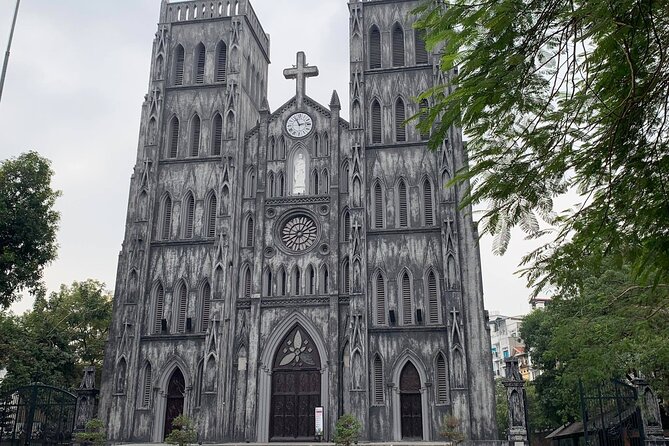
St. Joseph’s Cathedral is one of Hanoi’s most recognizable churches and is described here as the city’s largest Roman Catholic church. The tour allows 15 minutes for its story.
The important point is not simply the building’s appearance. You hear how the church was shut for more than 20 years during the Vietnam War. That detail places the cathedral within Hanoi’s political and religious history, rather than treating it as just a Gothic-style photo background.
Fifteen minutes is enough for an exterior explanation and photographs, but you should not expect an extended church visit. The tour information does not promise interior access, a service, or a guided look inside.
This is also a useful moment to see how different layers of Hanoi sit side by side. The route has already covered the market, murals, railway corridor, and colonial architecture. The cathedral adds religion and wartime memory to the picture.
Hoan Kiem Lake and the sword legend
The walk then reaches Hoan Kiem Lake Walking Street for about 15 minutes. The stop focuses on the story of the sword lake, one of Hanoi’s best-known legends.
The lake is more than a scenic break. It is one of the places where Hanoi’s public life gathers, and the story attached to it helps explain why the area carries such symbolic weight. Your guide can connect the legend with the city’s identity in a way that a quick solo photograph cannot.
Because the stop is brief, you will probably get a concise telling of the tale and time for views rather than a full circuit of the lake. That is a fair trade on a route with nine stops. If the lake becomes a favorite, you can return later and walk it at a slower pace.
The walking-street setting can also make this section feel different from the market and Old Quarter lanes. You move from tight urban passages into a more open public space, which gives the morning a welcome change of pace.
Ly Thai To Park and the king who moved the capital
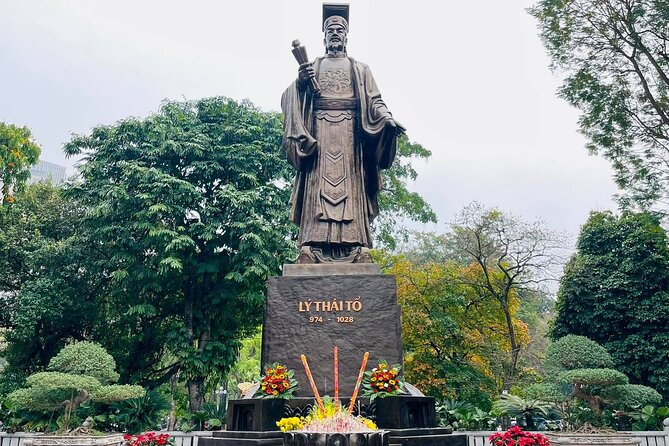
At Ly Thai To Park, you get close to the statue of the third king of Vietnam, credited here with moving the capital to the area now known as Hanoi. The stop lasts about 15 minutes.
This is a compact history lesson, but an important one. The decision to move the capital helps explain why Hanoi became the center of political life and why its monuments carry such strong national meaning.
The statue itself is the focus, yet the park also gives you a pause from enclosed streets. I like this kind of stop because it links a person, a decision, and the city you are standing in. It turns a statue into part of a larger story.
Again, do not expect a museum-length explanation. The benefit comes from seeing the monument in place and hearing the essential background before the route moves toward the Opera House district.
The Sofitel Metropole and Joan Baez in 1972
The Hanoia Metropole stop, referring to Hanoi’s Sofitel Metropole Hotel, brings a very different kind of history into the walk. The hotel is known for its famous visitors, including American folk singer and activist Joan Baez, who stayed there over Christmas in 1972.
The tour allows about 20 minutes here. The story connects the elegant hotel with the intense wartime events taking place in Hanoi at the time. That contrast makes the stop memorable: a grand hotel becomes a setting for political history, music, protest, and war.
The supplied details mention that Joan Baez was at the hotel when American bombing began in December 1972. The guide’s account may give the event more local context, but the stated route does not promise access inside the hotel or a visit to specific rooms.
This is a good example of the tour’s wider strength. You are not only hearing about kings and churches. You are also hearing how international figures and major world events intersected with ordinary places in Hanoi.
Ending at the Opera House and the August Uprising
The walk ends at Hanoi Opera House, at 1 Tràng Tiền, after about 20 minutes at the final stop. The location is tied to the August Uprising of 1945, making it a logical endpoint for a route built around Hanoi’s political and social past.
Ending here is practical as well as meaningful. You finish in central Hanoi, near major streets and public transport, instead of being returned to the starting market. From here, you can continue exploring on foot or use the area as a base for your next plan.
The Opera House itself is one of the city’s most recognizable colonial-era buildings, but the tour’s emphasis is the historical event connected with the site. You should think of this as an exterior stop and concluding explanation unless the guide tells you otherwise.
I like the route’s sense of direction. It begins with trade and wartime history, passes through cultural and religious sites, then finishes at a place tied to national change. The stops are short, but together they form a clear morning outline of Hanoi.
What $15 buys you
At $15 per person, this is inexpensive for a three-hour guided walk in central Hanoi. All listed stops have free admission, so the price mainly pays for the guide, route planning, historical explanation, and the convenience of moving between places without having to work out the city yourself.
That value is strongest if you are new to Hanoi. A food tour review describes a guided outing as a good way to get your bearings, and this walking route offers a similar benefit without making food the main focus. You can use the tour to decide which areas deserve a second visit.
The price is less compelling if you want long visits inside buildings, substantial free time, or a private guide. Nine stops in three hours is an efficient survey, not a slow architectural study.
The mobile ticket is convenient, and confirmation is sent within 48 hours of booking, subject to availability. The tour requires a minimum number of participants, and the group can include up to 15 people. It is listed as suitable for most people, near public transportation, and service animals are allowed.
Cancellation terms are strict. The experience is non-refundable and cannot be changed for any reason. If poor weather cancels the tour, or if the minimum group size is not met, you are offered another date or experience, or a full refund.
Who should book this Hanoi walk
I would choose this tour for a first morning in Hanoi, especially if you want history and local streets more than a food-focused outing. It suits solo visitors, couples, and small groups who like asking questions and taking photographs while walking at a steady pace.
It is also useful for anyone who prefers a broad introduction. You see markets, public art, railway tracks, architecture, religion, legend, national history, and a famous hotel in one route.
I would hesitate if you dislike walking in traffic-heavy city streets, need long rest periods, or want guaranteed access to the railway area, cathedral interior, or hotel. The tour covers a lot, but it does so through short stops and exterior views.
Bring comfortable footwear, water, and a phone or camera. Arrive at Đồng Xuân Market before the 9:30 a.m. start, since the group begins moving quickly once introductions are over.
Should you book it?
Book this walk if you want a low-cost, well-shaped introduction to central Hanoi and value stories that connect ordinary streets with national events. The combination of Dong Xuan Market, the railway corridor, St. Joseph’s Cathedral, Hoan Kiem Lake, and the Opera House gives you a useful first map of the city.
Skip it if your priority is a private pace, extended food tasting, or long indoor sightseeing. For most first-time visitors, though, $15 is a sensible price for three hours of orientation, especially with guides such as Son or Mr. Vu who can add local detail, humor, and flexibility to the route.
FAQ
How long does the Hanoi Highlights and Hidden Gems Walking Tour last?
The tour lasts approximately three hours.
What time does the tour start?
The scheduled start time is 9:30 a.m.
Where does the tour begin?
It begins at Đồng Xuân Market, Chợ Đồng Xuân, Đồng Xuân, Hoàn Kiếm, Hanoi.
Where does the tour end?
The tour ends at Hanoi Opera House, 1 Tràng Tiền, Phan Chu Trinh, Hoàn Kiếm, Hanoi.
How much does the tour cost?
The listed price is $15 per person.
How many people can join the tour?
The maximum group size is 15 travelers.
Are admission tickets included?
The itinerary lists free admission for each of the nine stops.
Is the tour refundable?
No. The experience is non-refundable and cannot be changed for any reason. If poor weather or an insufficient minimum group causes the operator to cancel, you are offered another date or experience, or a full refund.
Is the tour suitable for most people?
The activity states that most travelers can participate. It is near public transportation, and service animals are allowed.
Just added to the Hanoi list
- (TOP) Private car: Hanoi/Noi Bai Airport (HAN) from/to Ninh Binh★ 3.5 · 16 reviews
- Thang Long Water Puppet Theater★ 4.5 · 45 reviews
- Private car transfer from Hanoi Airport to Hotels★ 4.5 · 5 reviews
- Private Tour Ninh Binh 1 Day★ 5.0 · 5 reviews
- Private Hanoi Old Quarter Food Tour with 8+ Authentic Tastings★ 5.0 · 11 reviews
- Private Transfer Service from Hanoi to Ha Long Bay★ 5.0 · 3 reviews
- Private Transfer Between Hanoi City and Noi Bai Airport (HAN)★ 5.0 · 3 reviews
- Ba Be National Park With Boat Trip, Kayaking, Swimming, Trekking And Cycling★ 5.0 · 10 reviews
Hanoi Walking Tours, compared.

[HOT] Hanoi Old Quarter Walking Street Food – Small Group Tour
Read our review →


Private Hanoi Street Food Walking Tour With Real Foodie
Read our review →

Hanoi Walking Street Food Tour with Train-Street Visit
Read our review →
Ha Noi Walking Food Tour, Non Vegetarian,Vegan, vegetarian Option
Read our review →
Tasting 8 Different Street Foods + Local Drink at Evening Time by Walking
Read our review →Browse the lists this tour appears in